Control-plane bootstrap and Calico networking
Recorded 2026-10-14. Commands run inside the RHEL VM. Historical creation commands are not instructions to recreate an existing cluster.
Verified outcome and remaining work
Kubernetes 1.36.5 initialised successfully on lab-control-01. The API server,
etcd, controller manager, scheduler and kube-proxy were Running. The node was
NotReady and both CoreDNS Pods were Pending before the Pod network was installed.
The Calico 3.33.0 operator subsequently reached 1/1 Running with no restarts.
Subsequent verification confirmed the node Ready, both CoreDNS Pods Running, and Calico Available with no degradation. The IP pool and internal/external Pod DNS lookups were reported correct. See the verification update below. Worker joins, cross-node connectivity and application deployments remain pending. The bootstrap-success screenshot contains a join token and is excluded from public evidence; the non-sensitive results above were transcribed instead.
Runtime and address verification
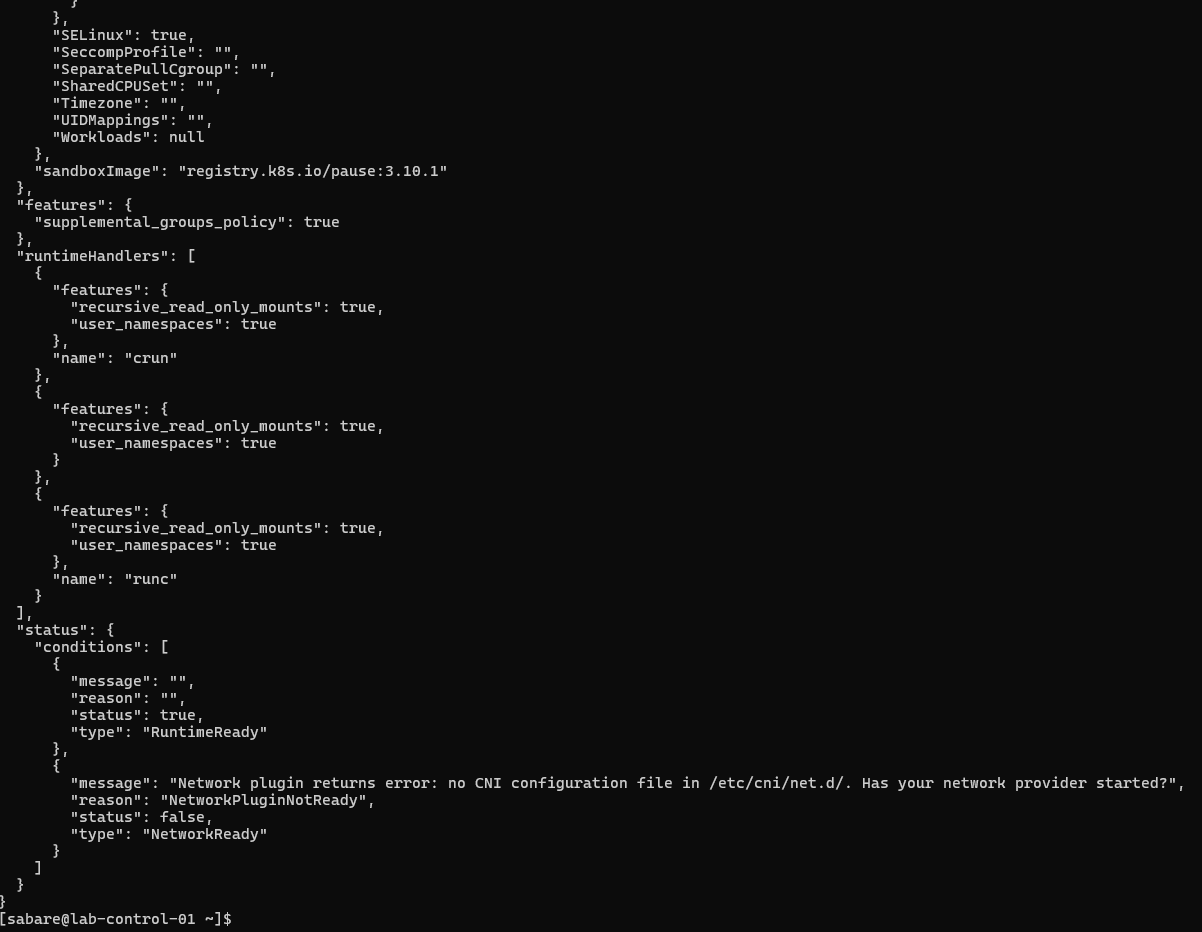
sudo crictl version
sudo crictl info
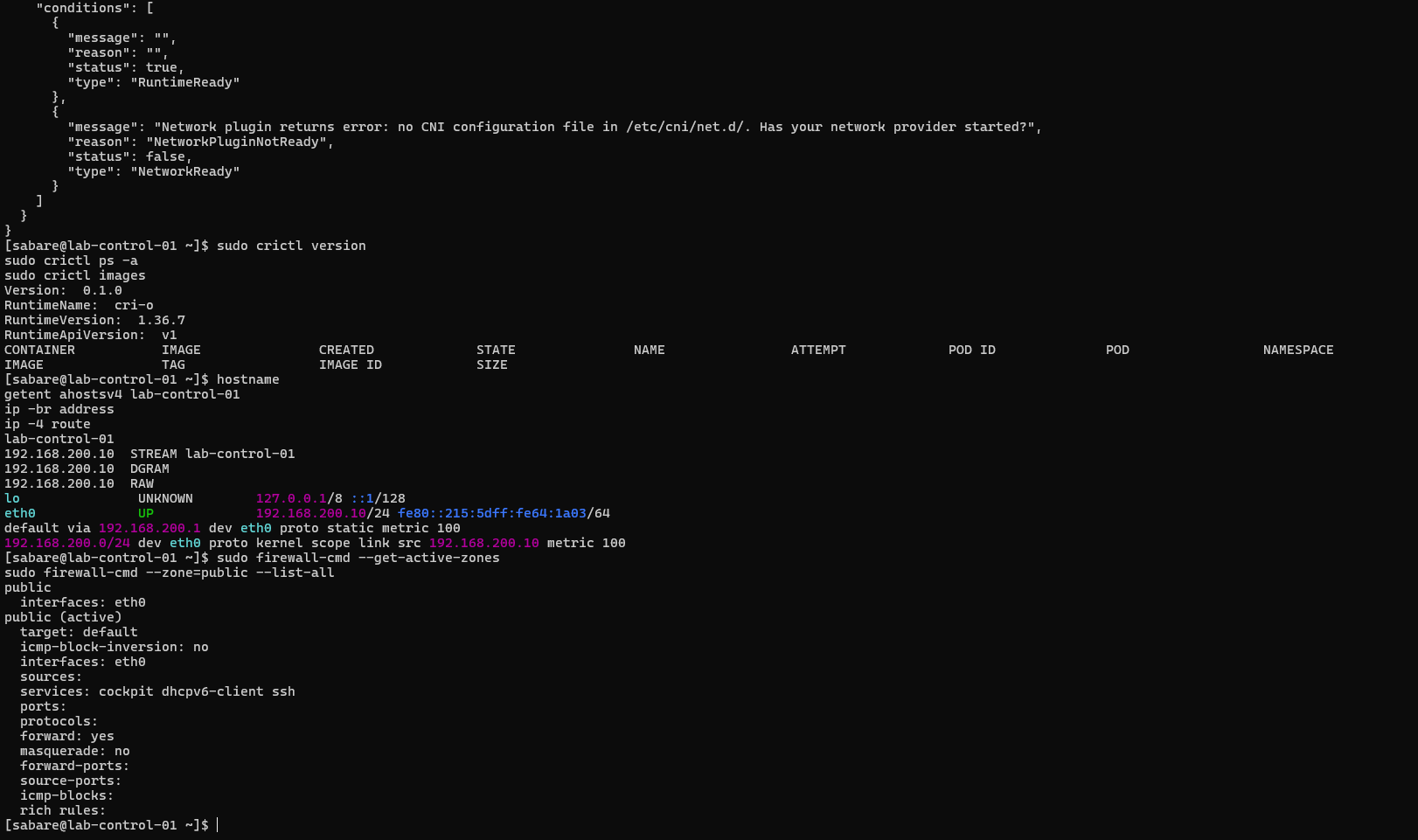
sudo crictl ps -a
sudo crictl images
hostname
getent ahostsv4 lab-control-01
ip -br address
ip -4 route
crictl talks directly to CRI-O through the configured Unix socket. It reported CRI-O 1.36.7, CRI API v1 and RuntimeReady true. NetworkReady false reported no CNI configuration; this was expected before installing the network. Empty container/image lists were historical results before bootstrap.
| Network | Range | Purpose |
|---|---|---|
| Hyper-V VM network | 192.168.200.0/24 | Node addresses; gateway 192.168.200.1 |
| Pod network | 10.244.0.0/16 | Application Pod addresses managed by Calico |
| Service network | 10.96.0.0/12 | Kubernetes virtual Service addresses |
These ranges do not overlap the known local networks. Future VPN routes must also be checked before connecting the lab to additional networks.
Firewall and host preparation
Initially, firewalld rich rules allowed TCP 6443 from the VM and Pod networks, and TCP 10250 from the VM network. Runtime/permanent rules matched and SSH remained allowed. This intermediate configuration is preserved as history.
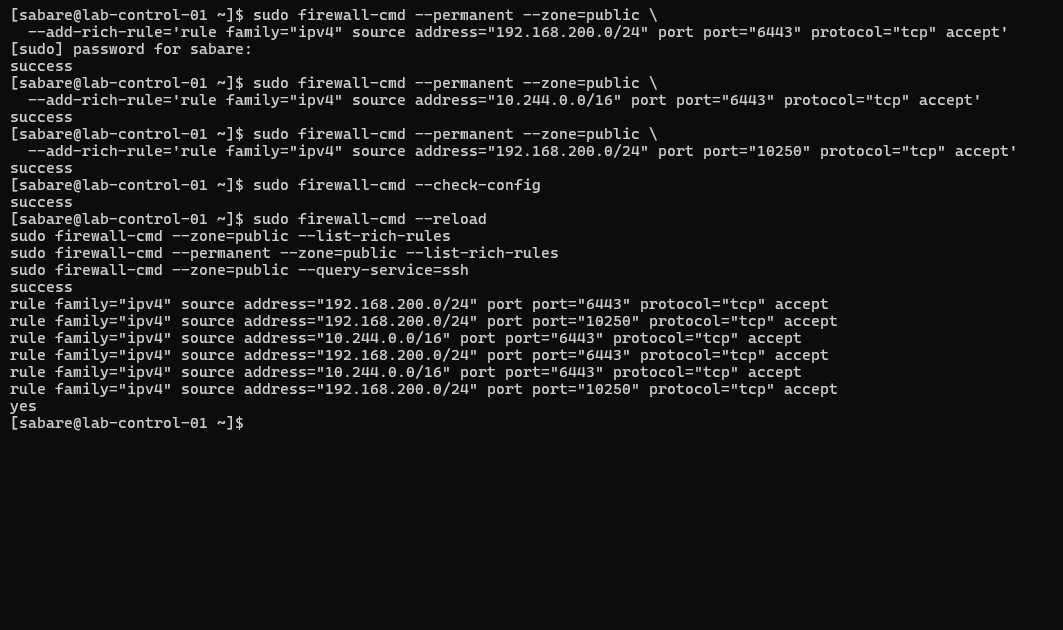
The subsequent Calico preparation followed its requirements to disable
firewalld, which can interfere with Calico-managed rules. The configuration was
backed up under /root/firewalld-before-calico-<timestamp>. Those earlier rules
are no longer enforced by firewalld. SELinux remains Enforcing. No Calico host
endpoint policies have been configured; Pod policies do not automatically
replace host protection. This is a private Hyper-V lab, not a production
firewall design.
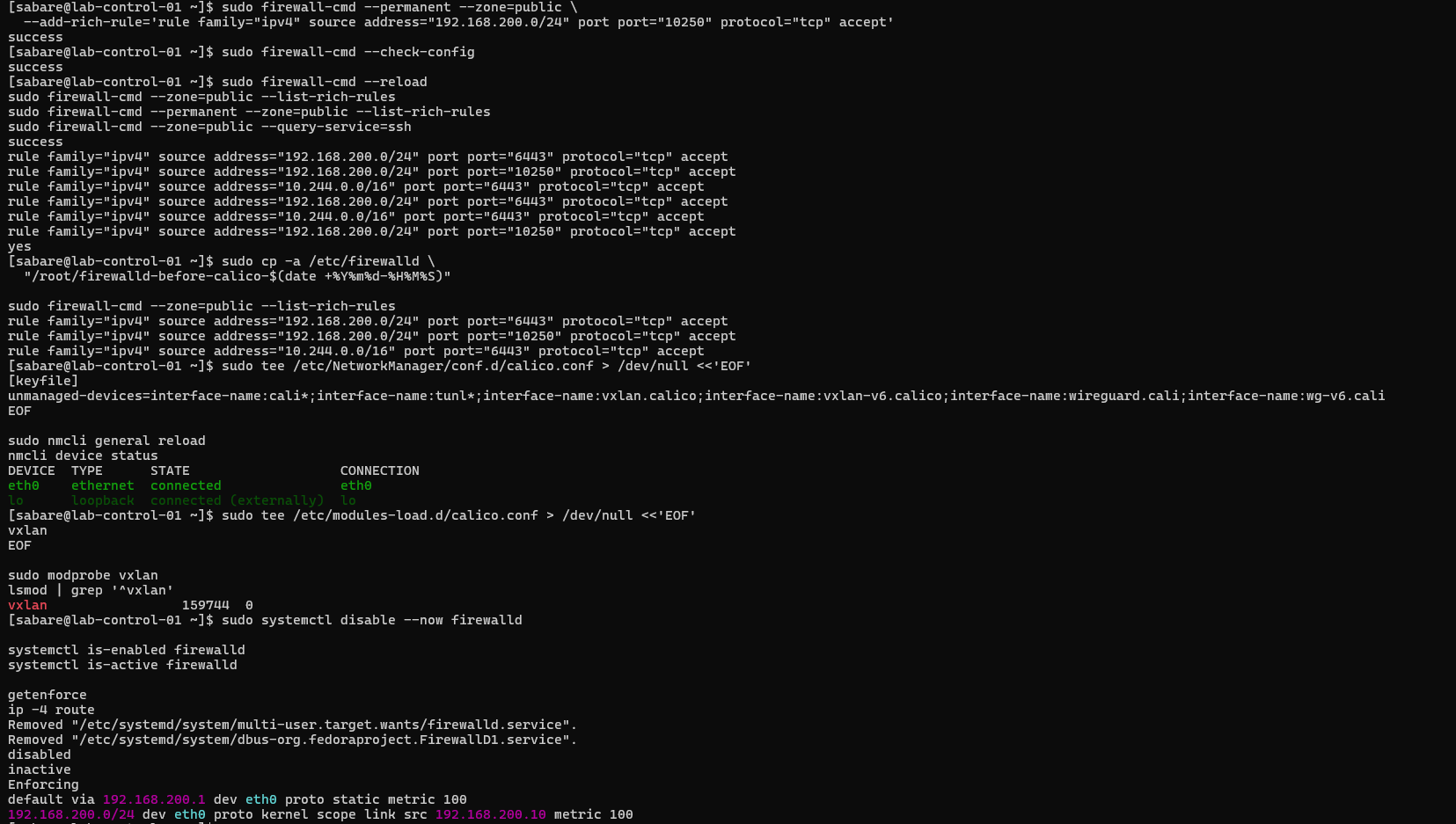
sudo tee /etc/NetworkManager/conf.d/calico.conf > /dev/null <<'EOF'
[keyfile]
unmanaged-devices=interface-name:cali*;interface-name:tunl*;interface-name:vxlan.calico;interface-name:vxlan-v6.calico;interface-name:wireguard.cali;interface-name:wg-v6.cali
EOF
sudo nmcli general reload
nmcli device status
sudo tee /etc/modules-load.d/calico.conf > /dev/null <<'EOF'
vxlan
EOF
sudo modprobe vxlan
sudo systemctl disable --now firewalld
systemctl is-enabled firewalld
systemctl is-active firewalld
getenforce
ip -4 route
NetworkManager must leave Calico interfaces alone. The VXLAN module enables encapsulated inter-node Pod traffic; its node-to-node transport uses UDP 4789. Observed results: module loaded, firewalld disabled/inactive, SELinux Enforcing, eth0 connected and the default route unchanged.
Bootstrap verification
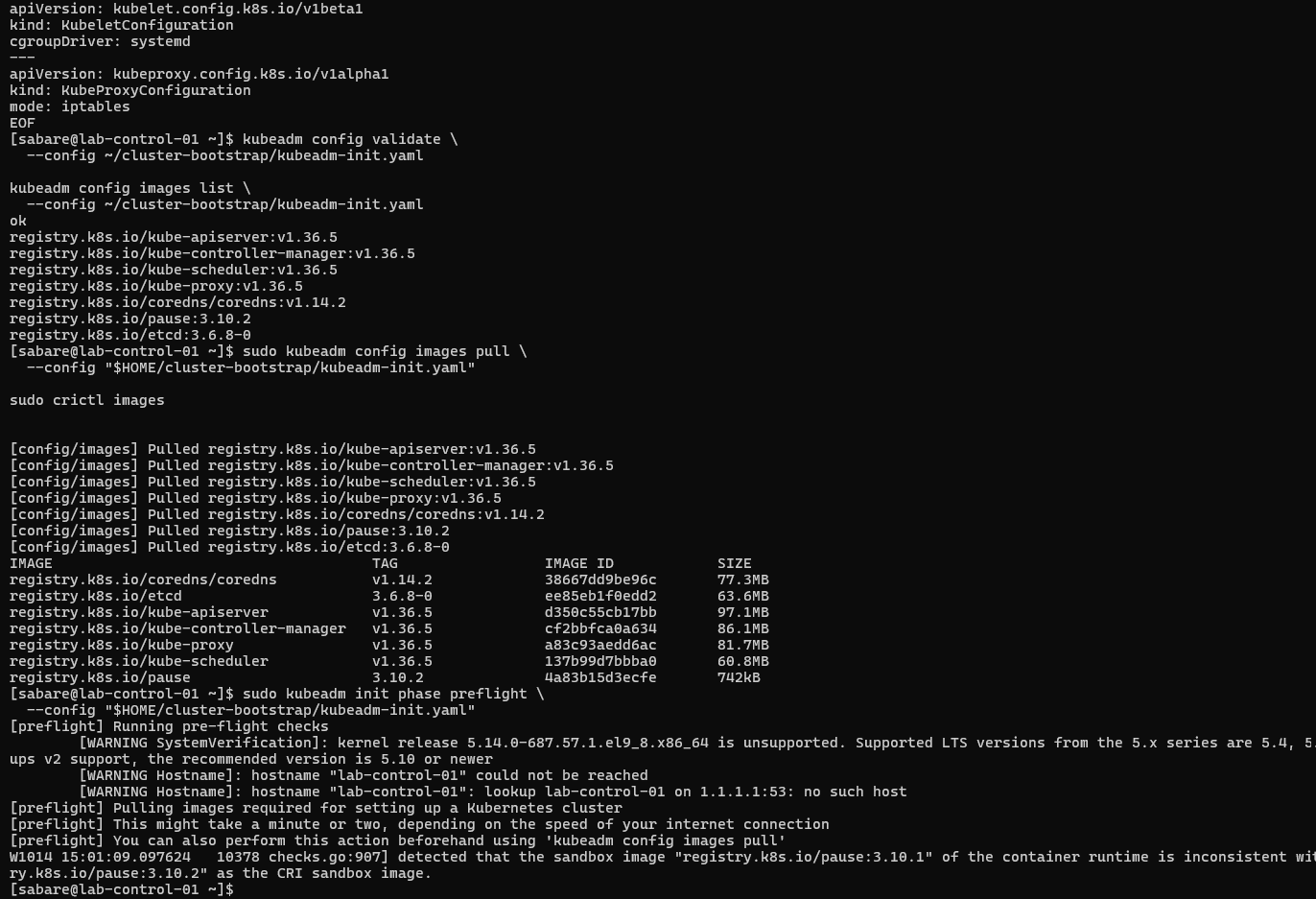
The guest configuration at ~/cluster-bootstrap/kubeadm-init.yaml selected
Kubernetes v1.36.5, API endpoint 192.168.200.10:6443, CRI-O socket
unix:///var/run/crio/crio.sock, the networks above, systemd cgroups and
kube-proxy iptables mode.
kubeadm config validate --config ~/cluster-bootstrap/kubeadm-init.yaml
sudo kubeadm config images pull --config "$HOME/cluster-bootstrap/kubeadm-init.yaml"
sudo crictl images
sudo kubeadm init phase preflight --config "$HOME/cluster-bootstrap/kubeadm-init.yaml"
Validation returned ok and images downloaded. Preflight completed with warnings: the vendor 5.14 kernel was not in the upstream LTS list, hostname DNS lookup failed, and CRI-O's pause 3.10.1 differed from kubeadm's 3.10.2. Hostname and pause image corrections were proposed, but separate confirmation of those corrections was not supplied. Successful bootstrap does not prove every warning was cleared or establish production support for this combination.
The subsequent command completed successfully; do not rerun it:
sudo kubeadm init --config "$HOME/cluster-bootstrap/kubeadm-init.yaml"
The administrator configured kubectl locally and inspected the cluster:
mkdir -p "$HOME/.kube"
sudo install -o "$(id -u)" -g "$(id -g)" -m 600 \
  /etc/kubernetes/admin.conf "$HOME/.kube/config"
kubectl cluster-info
kubectl get nodes -o wide
kubectl get pods -n kube-system -o wide
Keep the generated kubeconfig and join tokens out of Git. At this stage the control-plane containers were Running; node readiness awaited networking.
Operator installation
Calico v3.33.0 manifests were downloaded from the pinned upstream tag into
~/cluster-bootstrap/calico. The v3 CRDs were created before the operator:
kubectl create -f v3_projectcalico_org.yaml
kubectl create -f tigera-operator.yaml
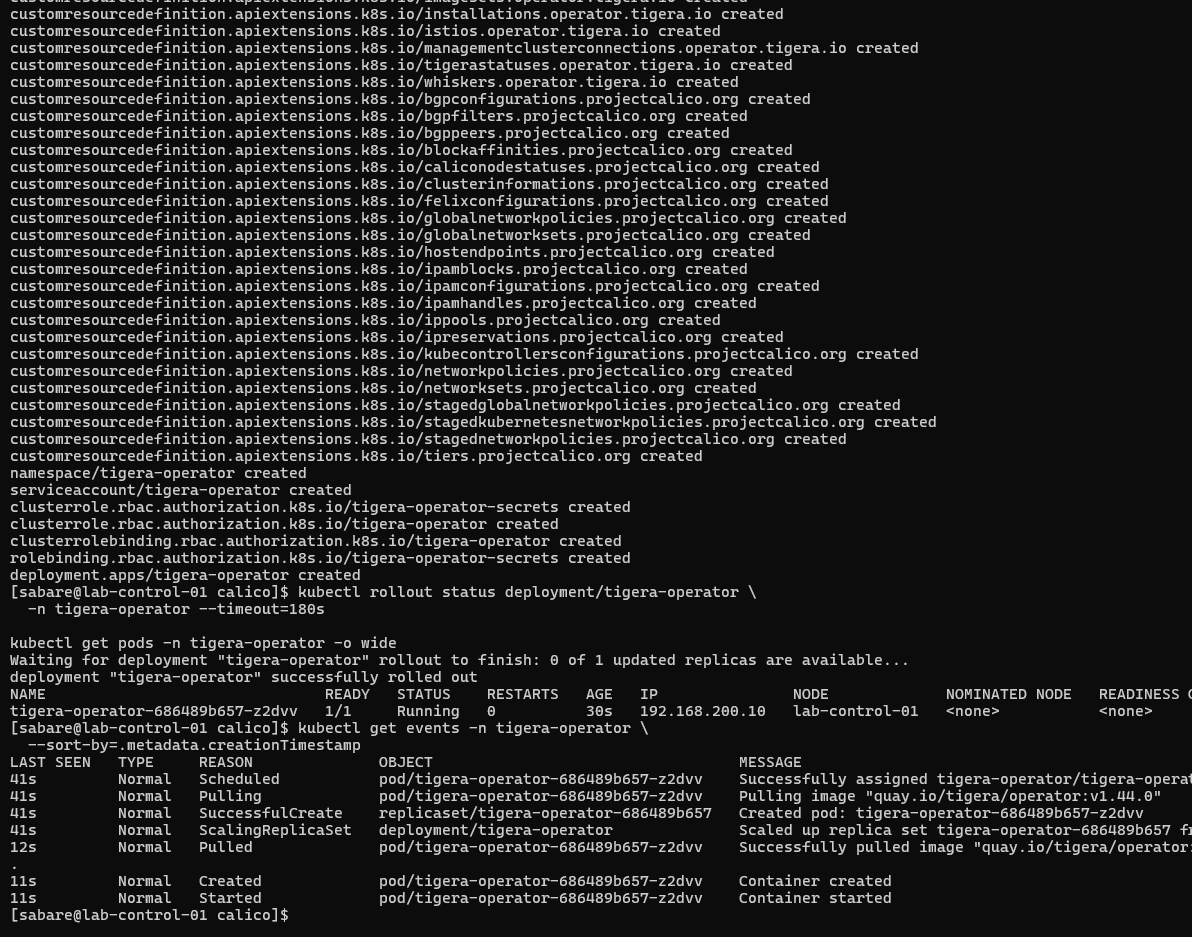
kubectl rollout status deployment/tigera-operator -n tigera-operator --timeout=180s
kubectl get pods -n tigera-operator -o wide
kubectl get events -n tigera-operator --sort-by=.metadata.creationTimestamp
The rollout succeeded, with 1/1 Running and normal image-pull/start events. Operator readiness alone does not establish Pod-network readiness.
Configure VXLAN (subsequently completed)
Copy the contents of the prepared Installation manifest
to ~/cluster-bootstrap/calico/calico-installation.yaml in the VM.
bgp: Disableddisables BGP route exchange.encapsulation: VXLANuses VXLAN for cross-node traffic, including nodes on the same subnet; this is not the CrossSubnet setting.cidrmatches the kubeadm Pod subnet./26is an allocation block size, not a limit of 64 Pods for the entire cluster.natOutgoing: Enabledtranslates outgoing Pod traffic to destinations outside Calico IP pools so the external network can return traffic to the node.linuxDataplane: Iptablesretains the selected dataplane and kube-proxy.
Validate against the installed API, then apply only if validation succeeds:
cd ~/cluster-bootstrap/calico
kubectl apply --dry-run=server -f calico-installation.yaml && \
  kubectl apply -f calico-installation.yaml
kubectl get installation.operator.tigera.io default
kubectl get tigerastatus
kubectl get pods -n calico-system -o wide
Allow reconciliation and image downloads, then inspect:
kubectl wait --for=condition=Ready node/lab-control-01 --timeout=180s
kubectl get nodes -o wide
kubectl get pods -n kube-system -o wide
kubectl get tigerastatus
sudo crictl info
A timeout calls for inspecting events and operator status, not rerunning kubeadm init. Node Ready, RuntimeReady/NetworkReady true and healthy system Pods are targets that were subsequently met, as recorded below. Cross-node connectivity requires workers and later tests. Optional observability components are deferred.
References
Verification update: networking ready
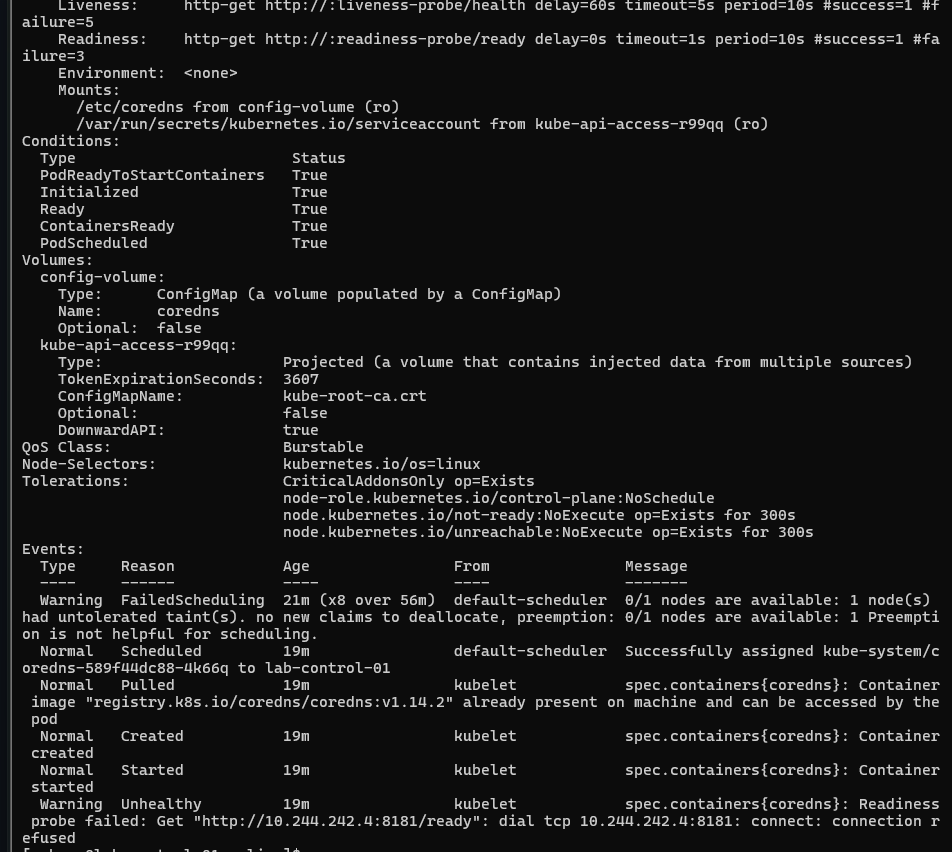
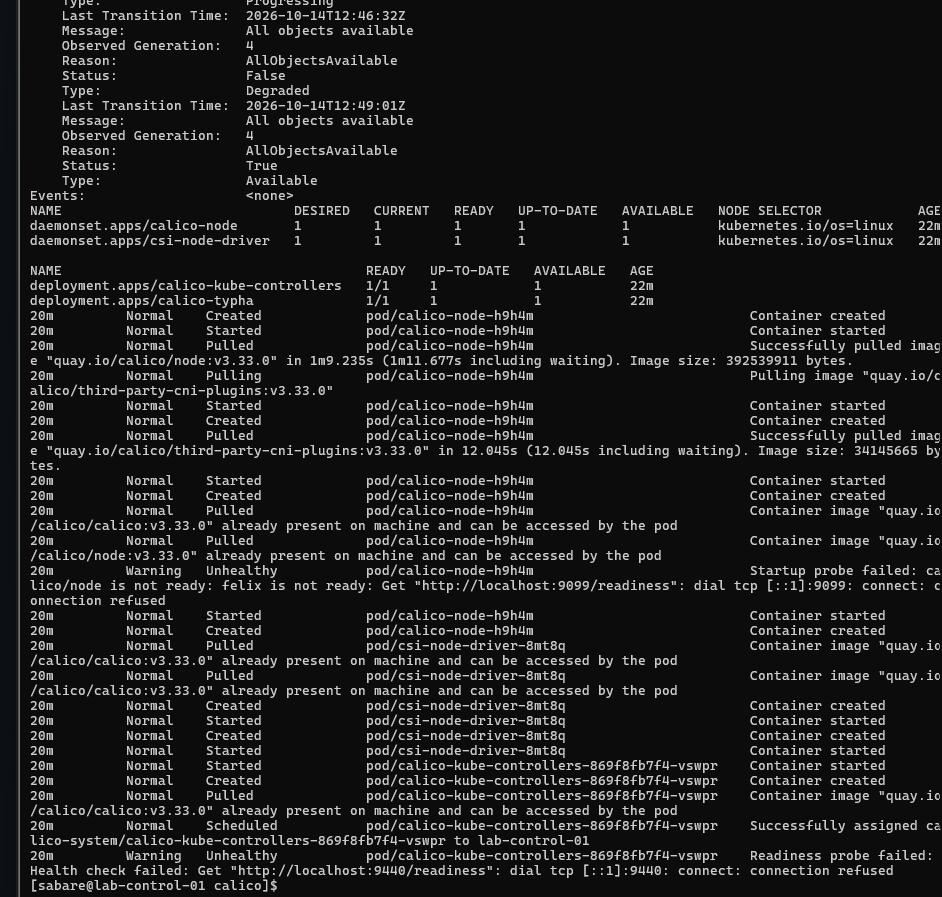
Fresh terminal output showed lab-control-01 Ready, Kubernetes v1.36.5 and CRI-O 1.36.7. Both CoreDNS Pods were 1/1 Running with zero restarts, at 10.244.242.3 and 10.244.242.4. Calico reported Available True, Progressing False, Degraded False; IP pools and tiers also reported all objects available.
Earlier FailedScheduling and connection-refused probe events were historical. The later Ready conditions and available components demonstrate recovery; no restart was required. Image downloads took time during startup.
The Installation resource confirms BGP Disabled, VXLAN encapsulation, Pod CIDR 10.244.0.0/16, outgoing NAT Enabled and the Iptables dataplane.
The original inspection command used the legacy ippools.crd.projectcalico.org
resource and failed. This installation uses native v3 resources. Correct commands:
kubectl api-resources --api-group=projectcalico.org
kubectl get ippools.projectcalico.org \
  -o custom-columns='NAME:.metadata.name,CIDR:.spec.cidr,VXLAN:.spec.vxlanMode,IPIP:.spec.ipipMode,NAT:.spec.natOutgoing'
The user reported the resulting pool was correct. The API-name error was not a network failure. See Calico native v3 CRDs.
Pod DNS test and cleanup
A temporary BusyBox 1.37.0 Pod named dns-check in default used a control-plane NoSchedule toleration, without changing the node taint. Service-account token mounting was disabled; resource requests were 10m CPU/16Mi RAM and limits 100m CPU/64Mi RAM. It ran sleep 3600 to allow these checks:
kubectl exec -n default dns-check -- cat /etc/resolv.conf
kubectl exec -n default dns-check -- nslookup kubernetes.default.svc.cluster.local
kubectl exec -n default dns-check -- nslookup www.redhat.com
kubectl delete pod dns-check -n default --ignore-not-found=true
kubectl get pod dns-check -n default --ignore-not-found=true
Both internal and external DNS lookups succeeded, and deletion was confirmed by the user. Full lookup answers were not supplied, so no specific resolved addresses are claimed. These checks verify single-node Pod DNS, not cross-node VXLAN traffic or network-policy enforcement.