Screenshot evidence index
Fifty-one screenshots from the current Hyper-V/RHEL rebuild are preserved
unchanged under the Wiki's images/ directory and embedded beside the relevant explanations.
They include intermediate states and failures, not just successful outcomes.
Installation sequence
See RHEL VM and installer guide.
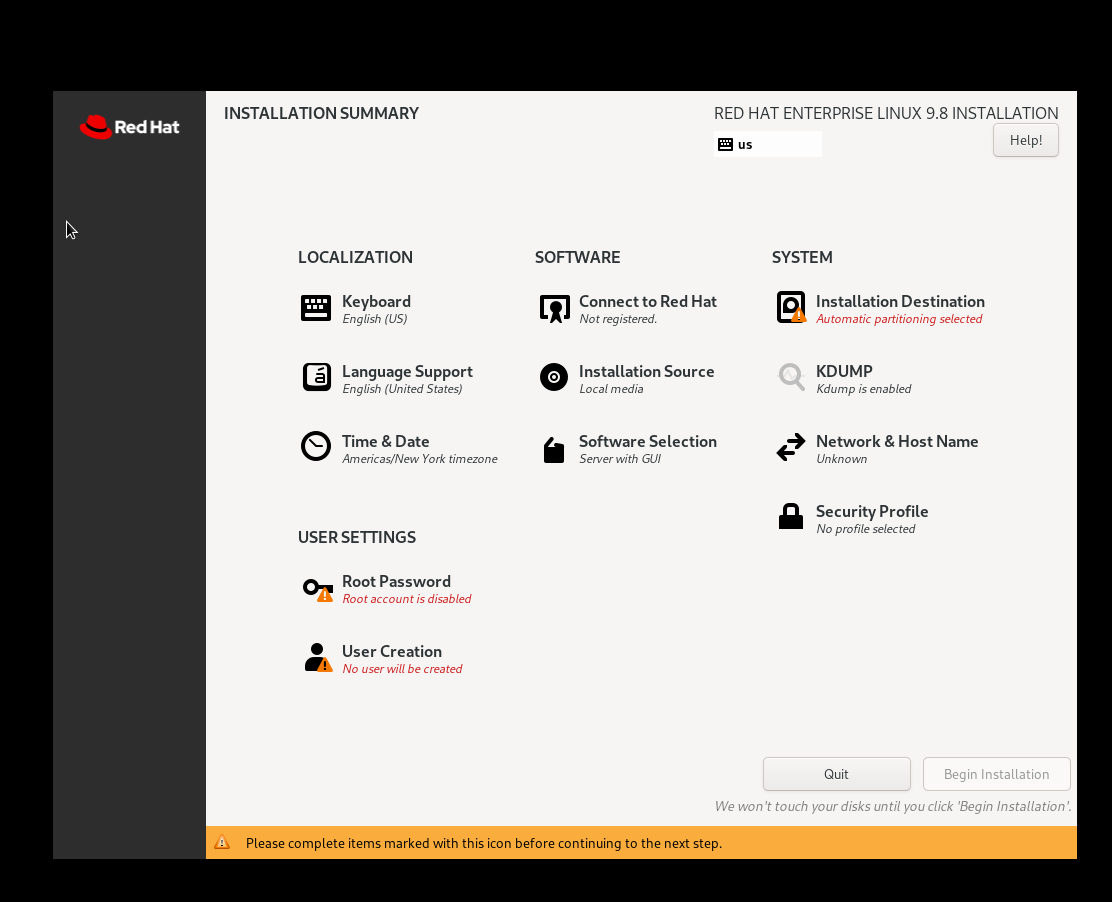
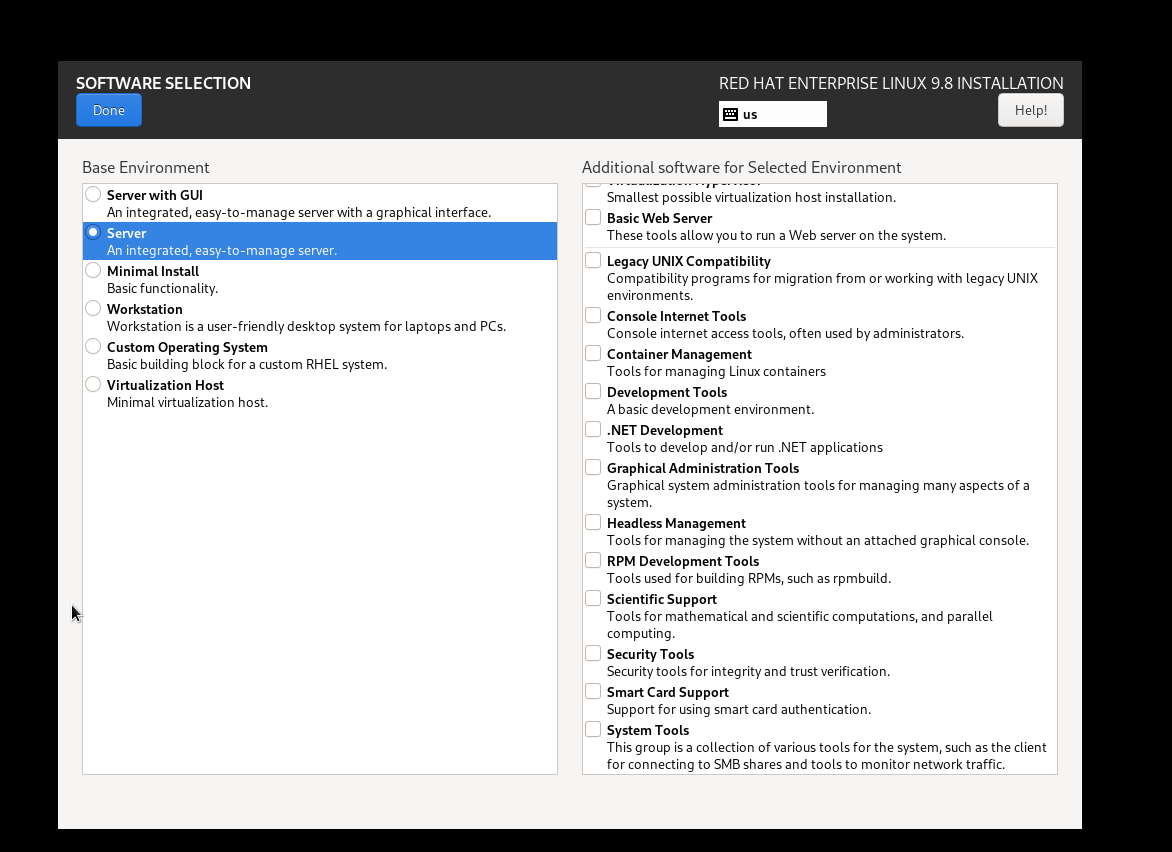
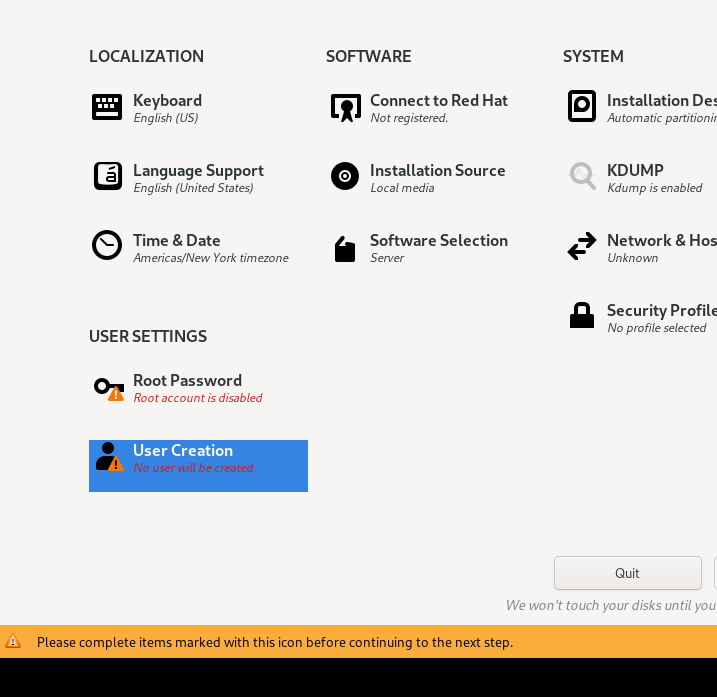
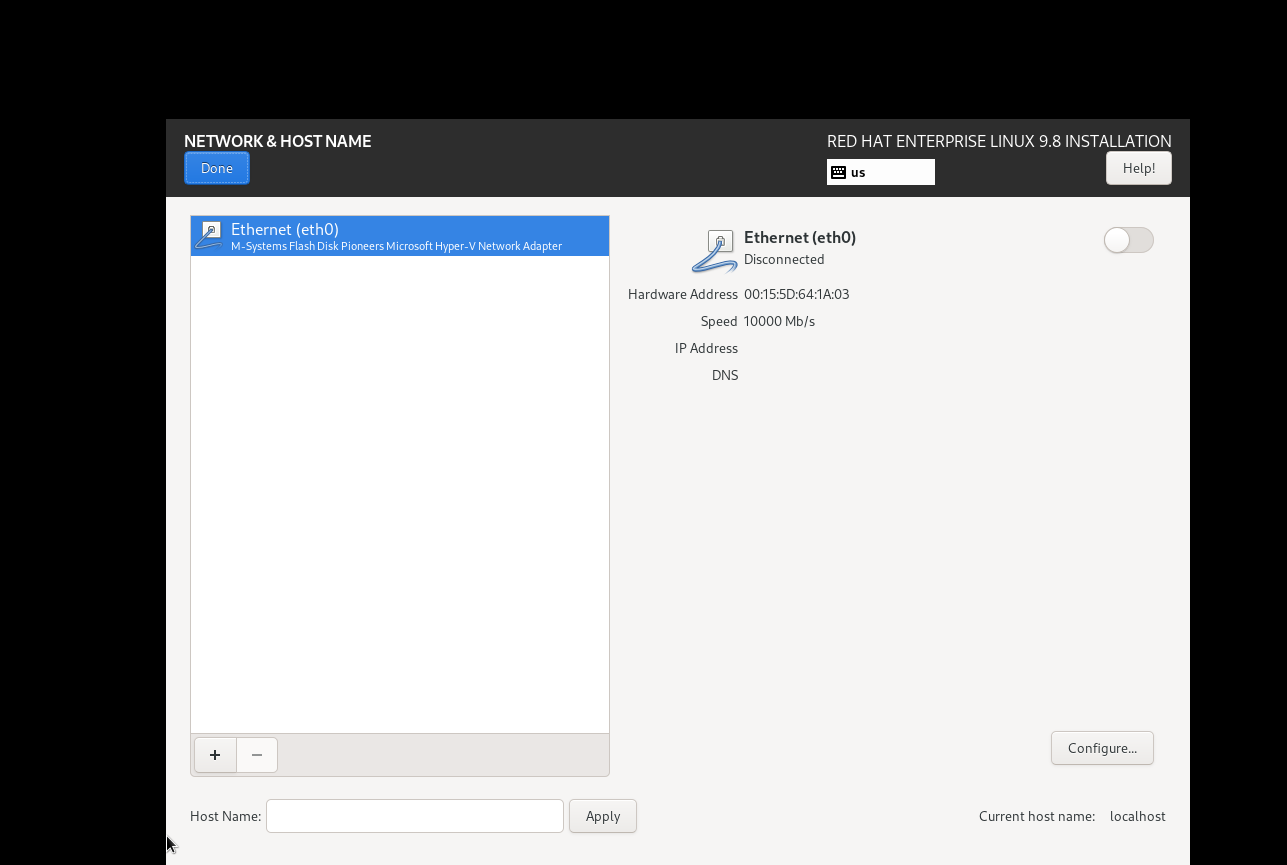
| Screenshot | What it records |
|---|---|
| Initial summary | Original installer defaults, before configuration |
| Server selection | Server base environment and unchecked optional add-ons |
| Account setup pending | Intermediate summary before user creation |
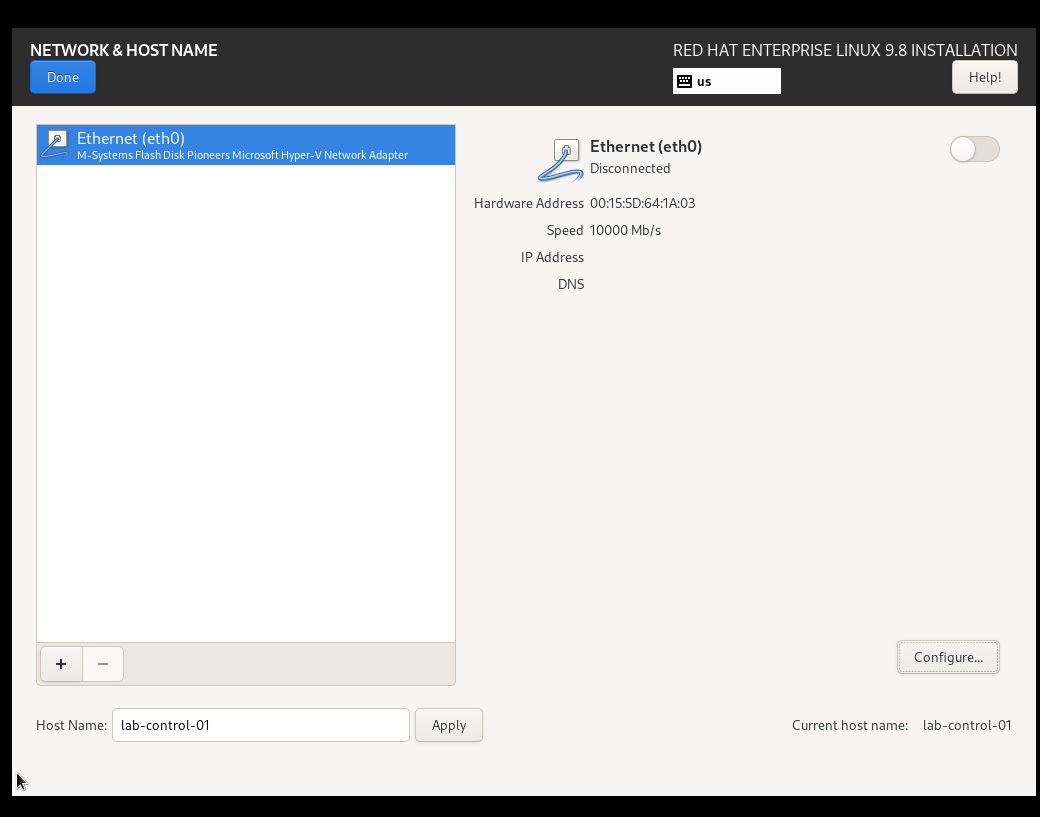
| Network before configuration | Adapter off, hostname still localhost |
| Hostname applied | lab-control-01 selected; adapter still off |
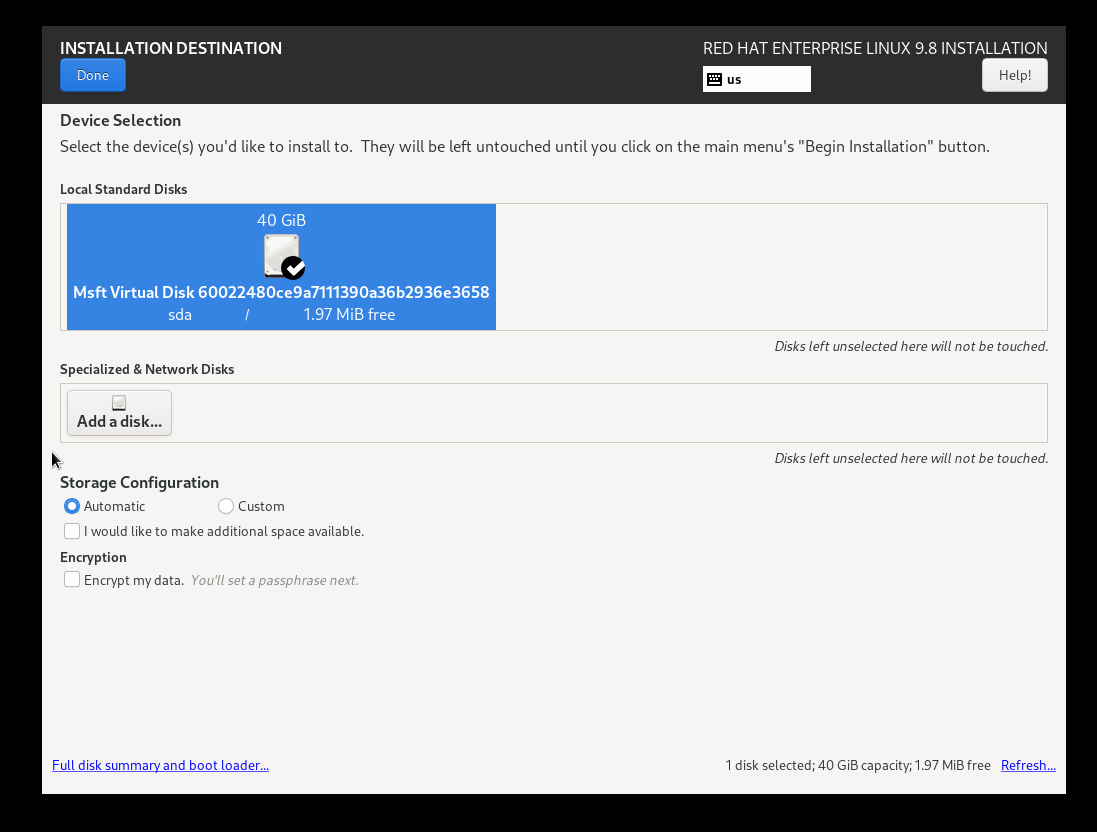
| Installation disk | 40 GiB virtual disk and Automatic partitioning |
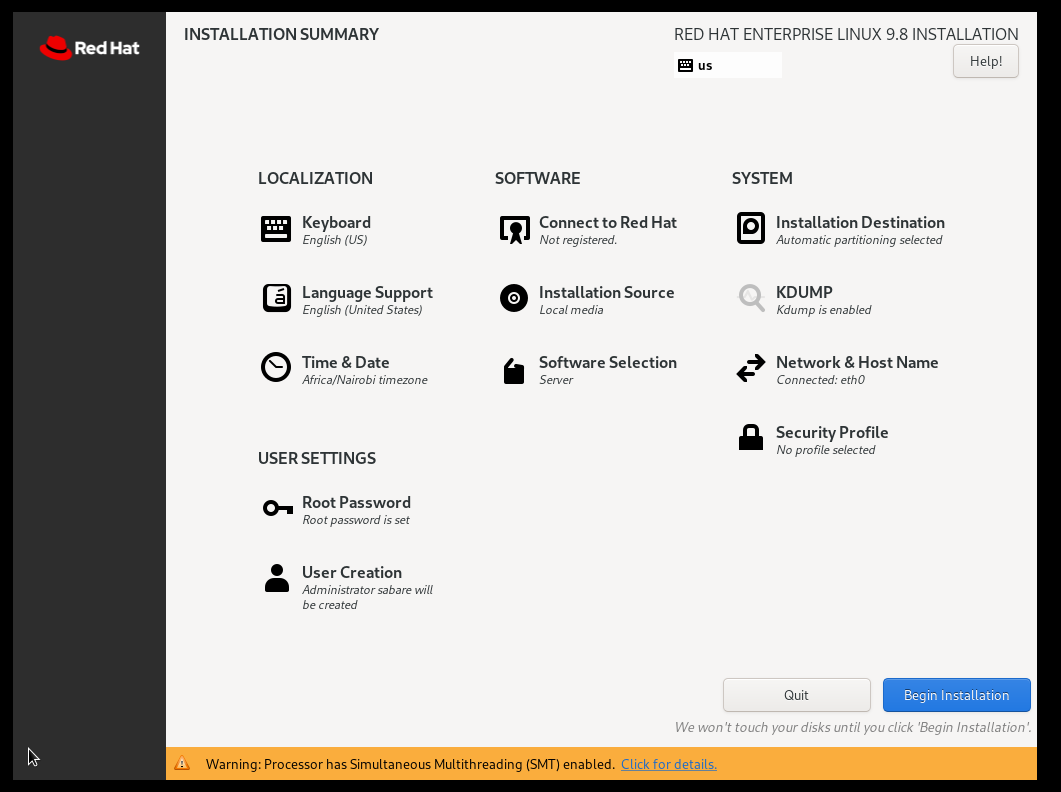
| Final installation summary | Final settings accepted before installation |
First boot and troubleshooting
| Screenshot | What it records |
|---|---|
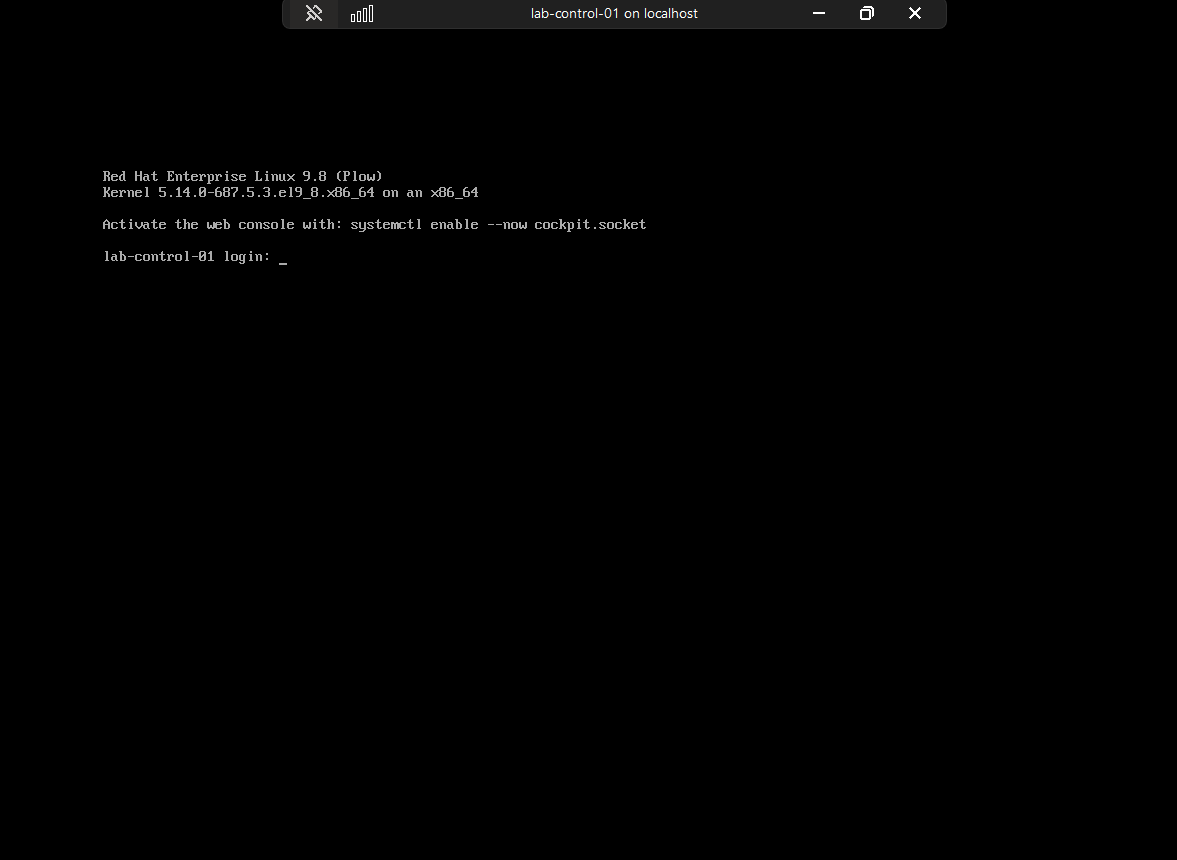
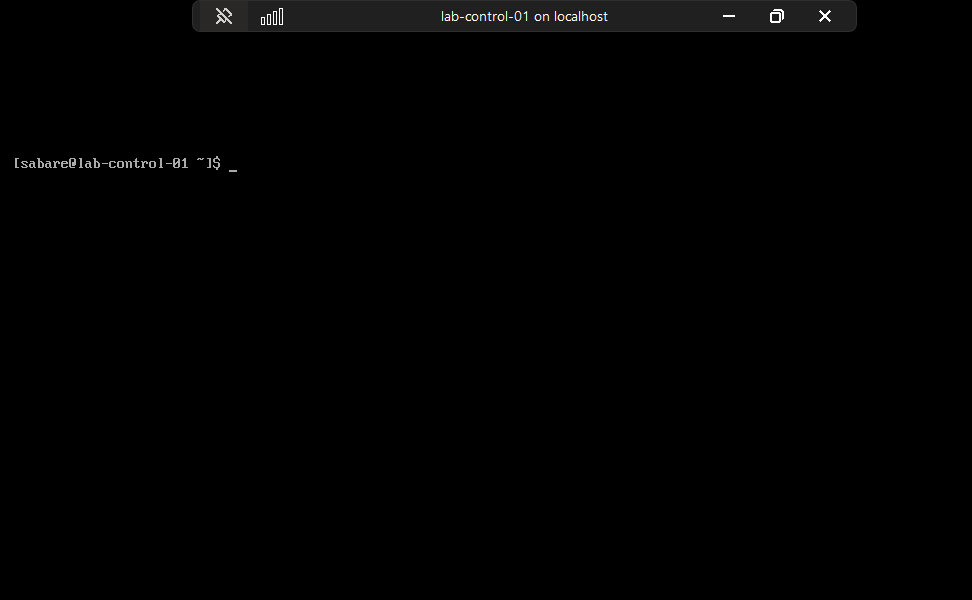
| First boot | Installed RHEL 9.8 reaches the login prompt |
| Console login | sabare reaches a local shell |
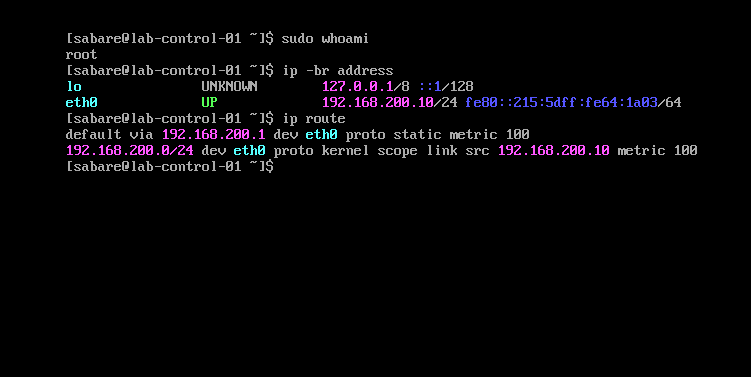
| Sudo and routing | Administrator access, IPv4 address and default route |
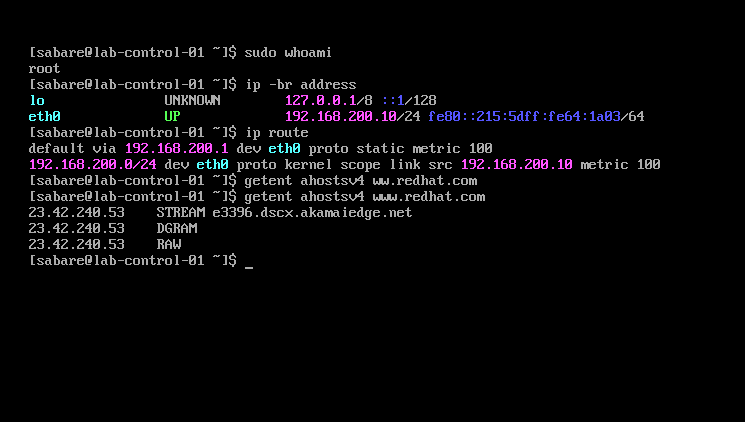
| DNS check | Corrected lookup resolves www.redhat.com |
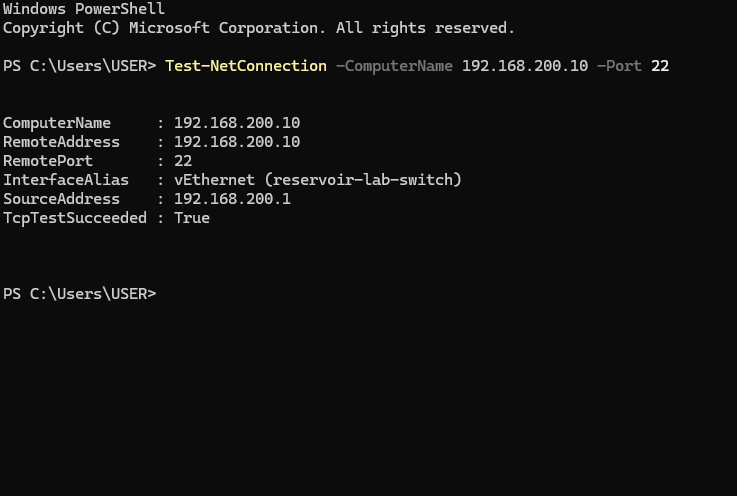
| Windows SSH port test | TCP port 22 reachable from Windows |
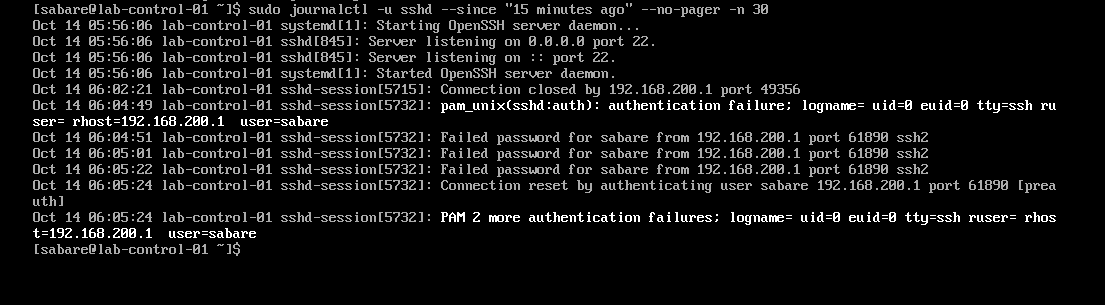
| SSH authentication log | Evidence used to diagnose initial password failures |
Selection boundaries
- Password-entry screens and output containing HTTP cookies are not published. The relevant configuration and HTTPS result are described in text instead.
- Screenshots from the retired Docker/kind/SQL lab are not evidence of this rebuilt platform. Personal storage cleanup screenshots are also outside scope.
- Later registration, successful SSH login and enabled repositories were reported in text; screenshots of those results were not supplied.
- RHEL metadata refresh and update-check success were reported in text; no screenshot is claimed for those results.
The images include local lab names, private network addresses and virtual device identifiers. They contain no employer infrastructure screenshots.
Node preparation and package installation
Nine additional originals were reviewed and copied from the Windows Pictures/Screenshots folder. They are embedded in node preparation. The latest image also matches the attachment supplied with this documentation request.
| Capture (2026-10-14, local time) | Screenshot | Evidence |
|---|---|---|
| 06:26:17 | Update preview | Preview only; Operation aborted is expected |
| 06:45:24 | Kernel and disks | Updated running kernel and LVM layout |
| 06:48:36 | Low memory | Historical low guest memory before fixed allocation |
| 07:01:53 | Swap disabled | Post-reboot Swap 0B and no active swap units |
| 07:04:02 | Node baseline | Historical inactive chronyd, security checks, no CRI-O yet |
| 07:12:39 | Time and networking | Synchronised clock, modules loaded, sysctl values 1 |
| 07:22:24 | CRI-O repository | Metadata and available versions, not installation proof |
| 14:15:14 | Kubernetes repository | Repository file and successful metadata refresh |
| 14:19:32 | Installed packages | Versions 1.36.5, kubelet enabled, CRI-O active |
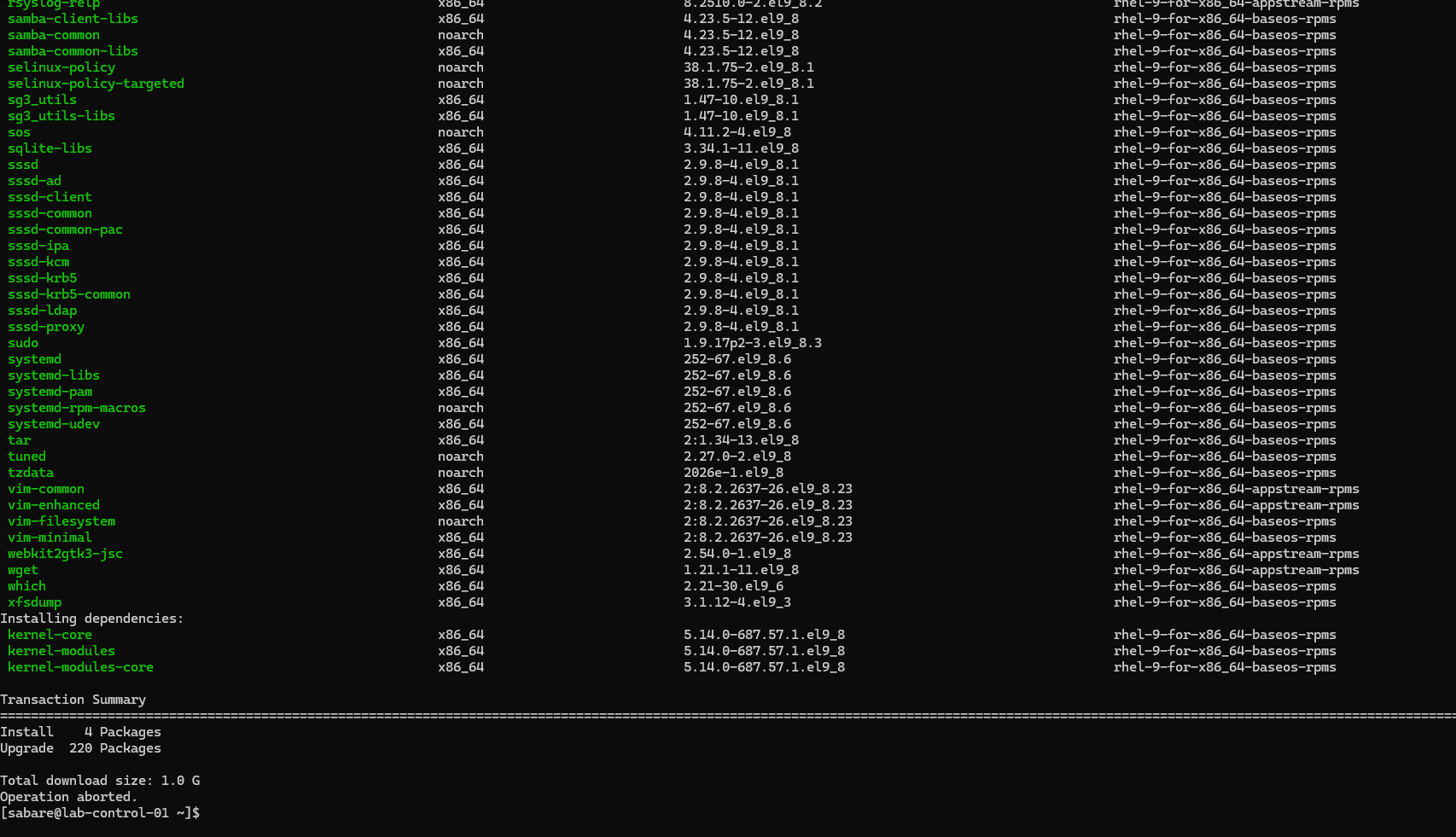
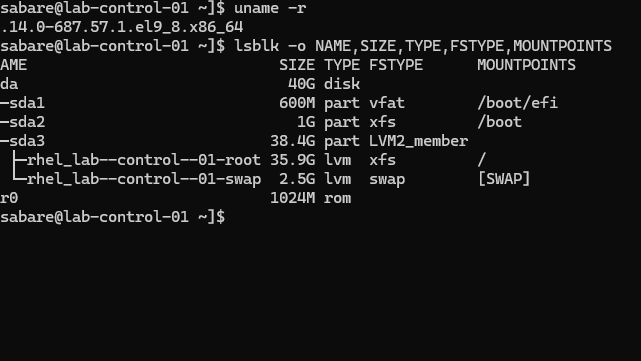
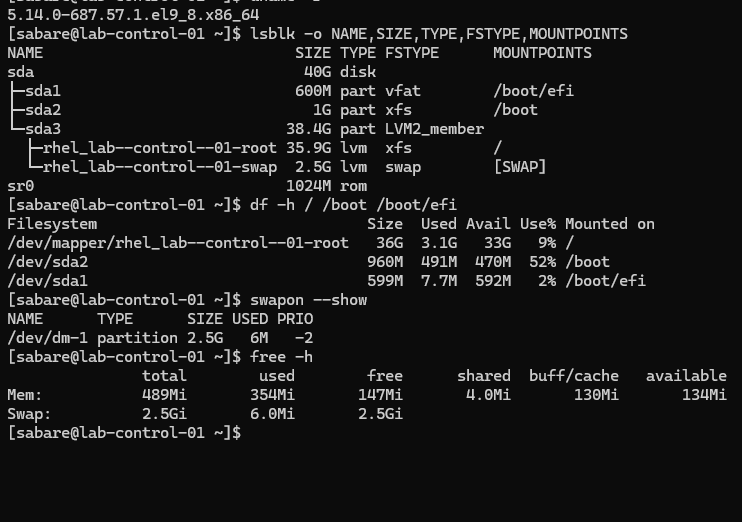
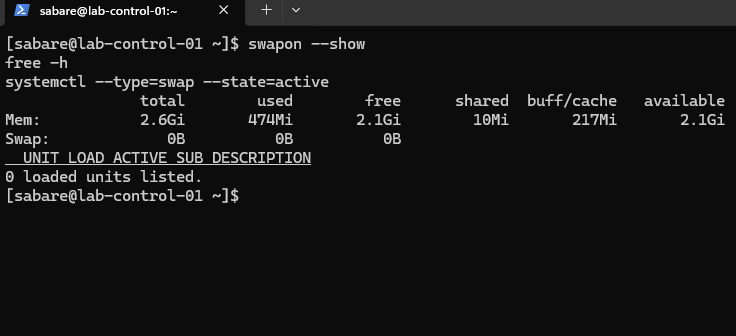
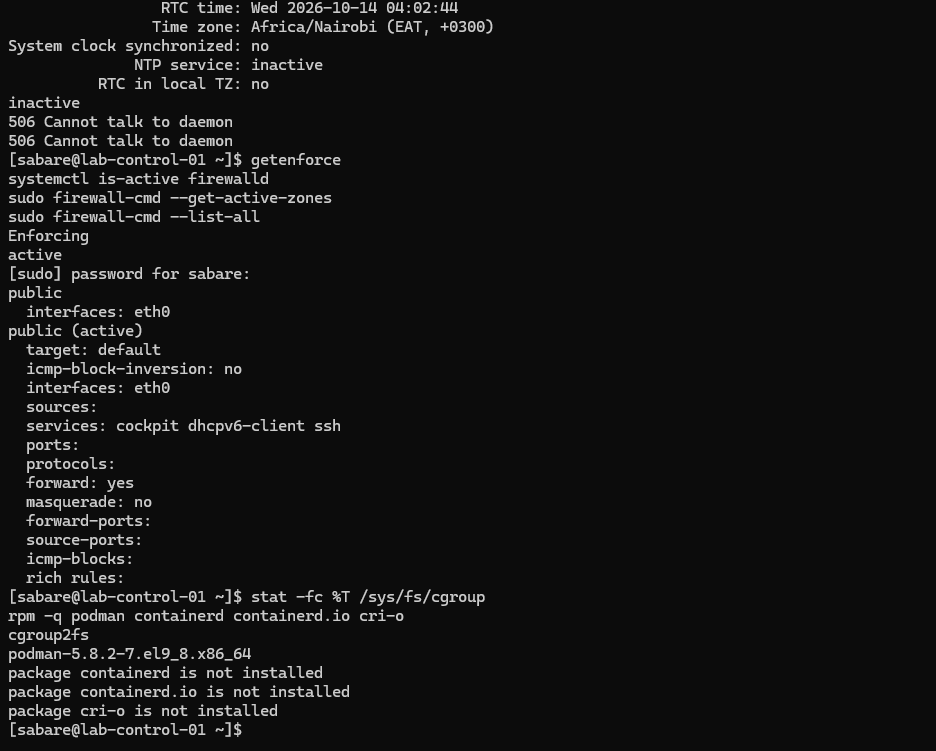
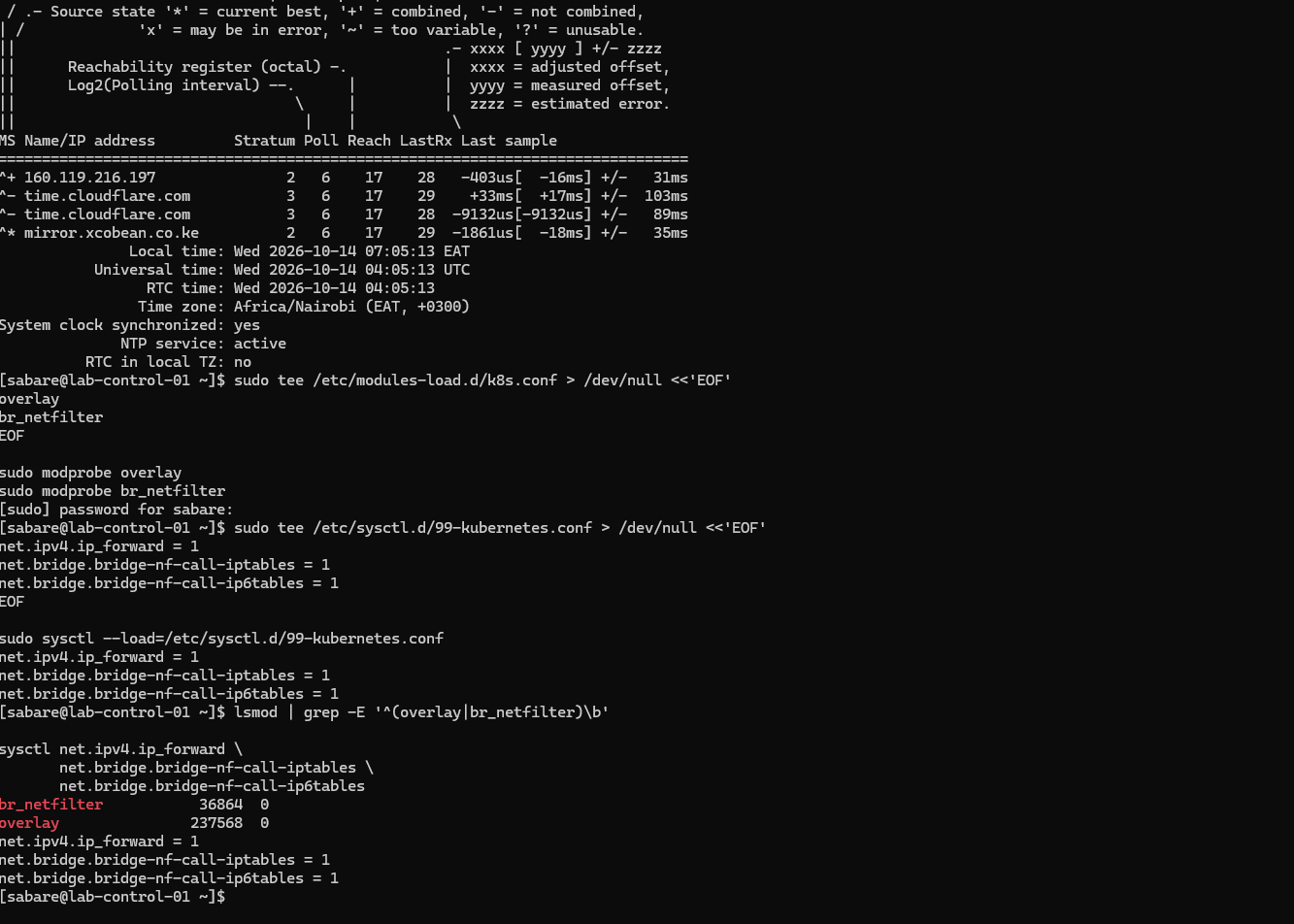
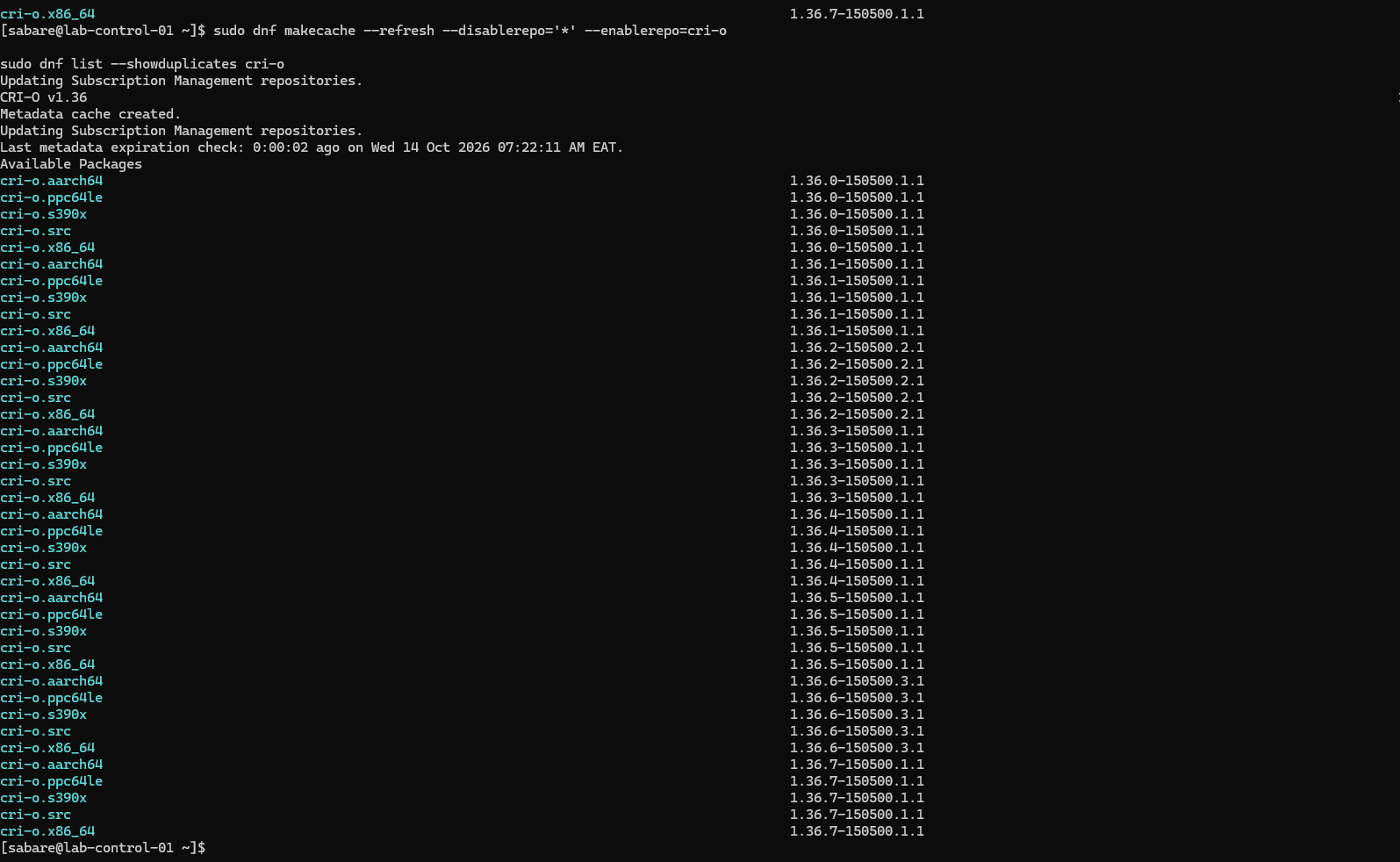
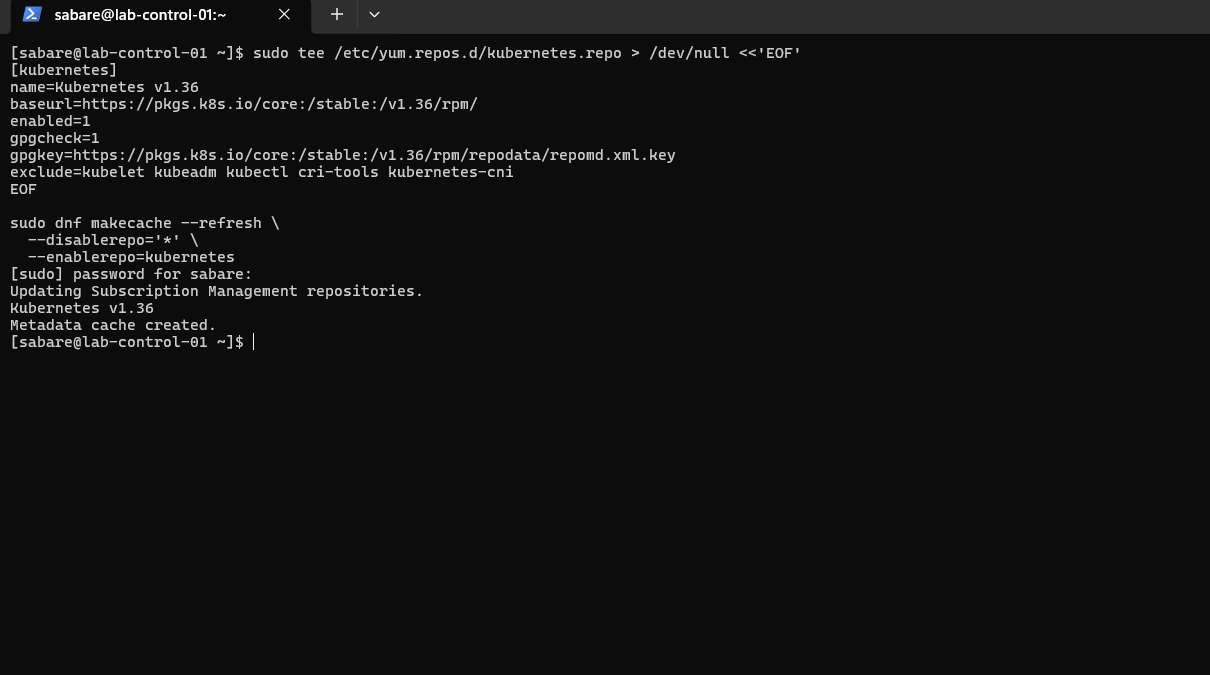
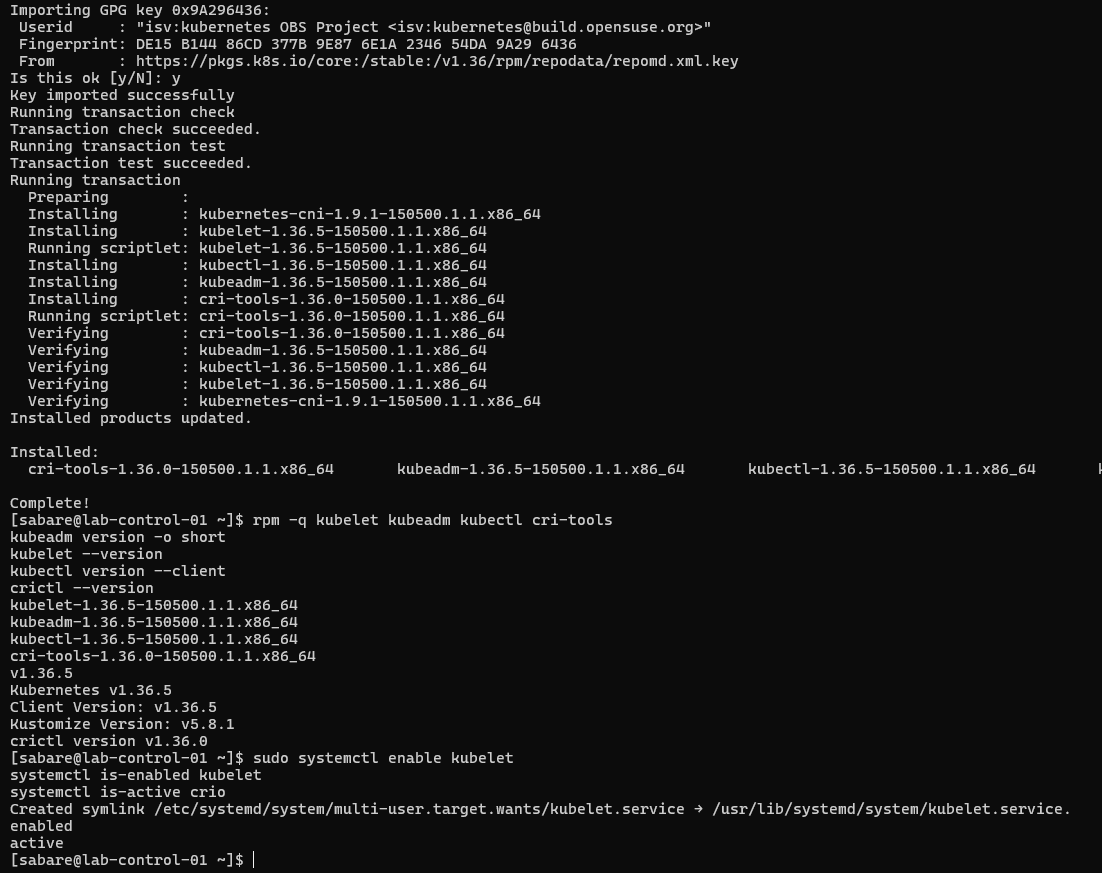
Capture times identify source files, not the time every command on screen ran. No credentials, registration IDs or cookie-bearing output were found in these nine images.
Runtime, bootstrap and Calico operator
Six further originals are embedded in the control-plane guide.
| Capture (2026-10-14, local time) | Screenshot | Evidence |
|---|---|---|
| 14:30:14 | Runtime ready | RuntimeReady true; CNI absent |
| 14:31:19 | Runtime API | CRI-O 1.36.7, CRI v1, VM routes |
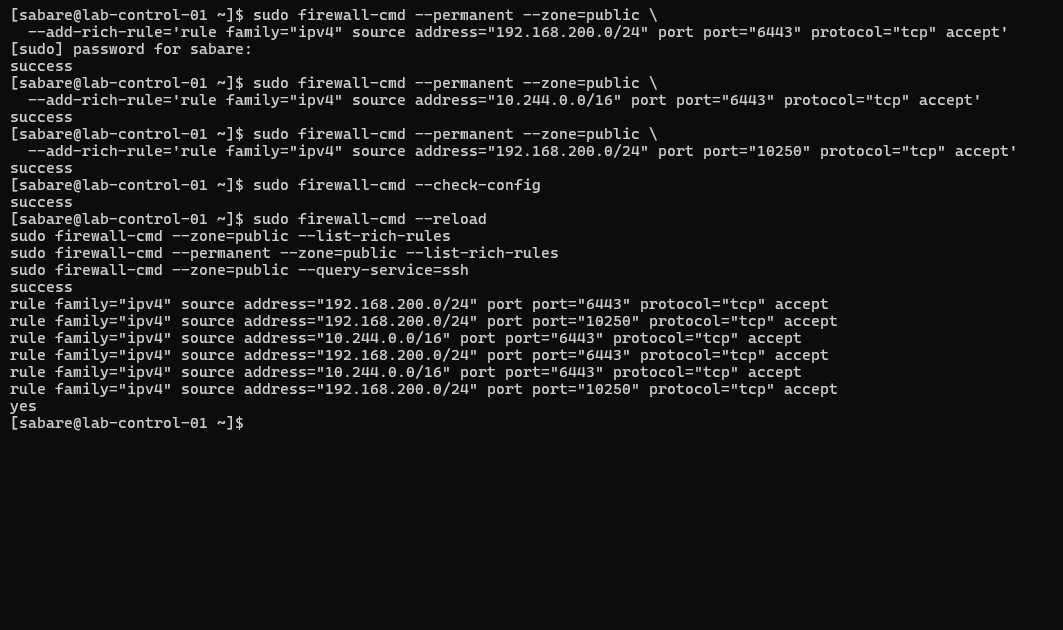
| 14:53:45 | Historical firewall rules | Rules verified before firewalld disabled |
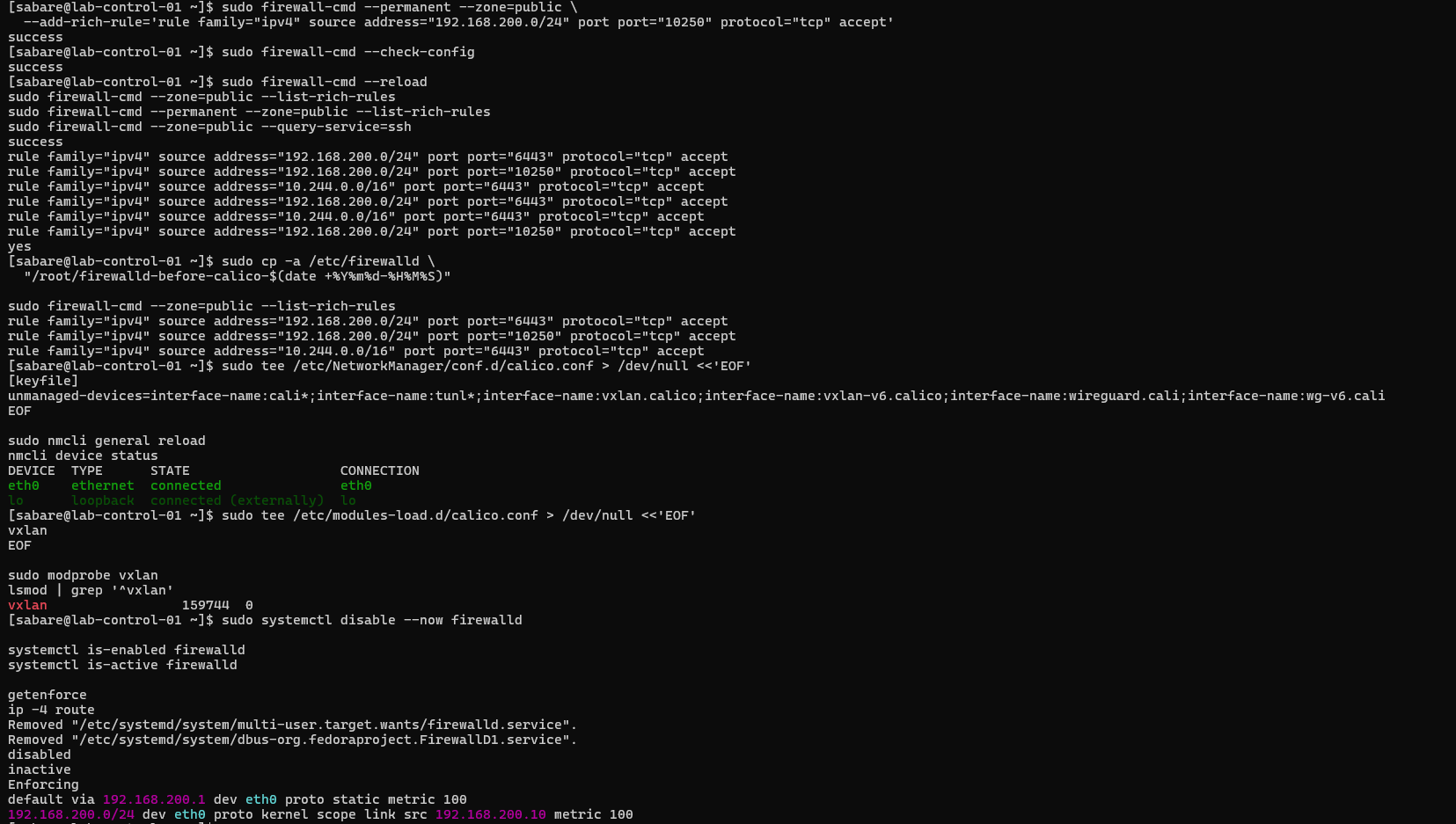
| 14:55:56 | Calico host preparation | NetworkManager exclusions, VXLAN, firewalld disabled, SELinux Enforcing |
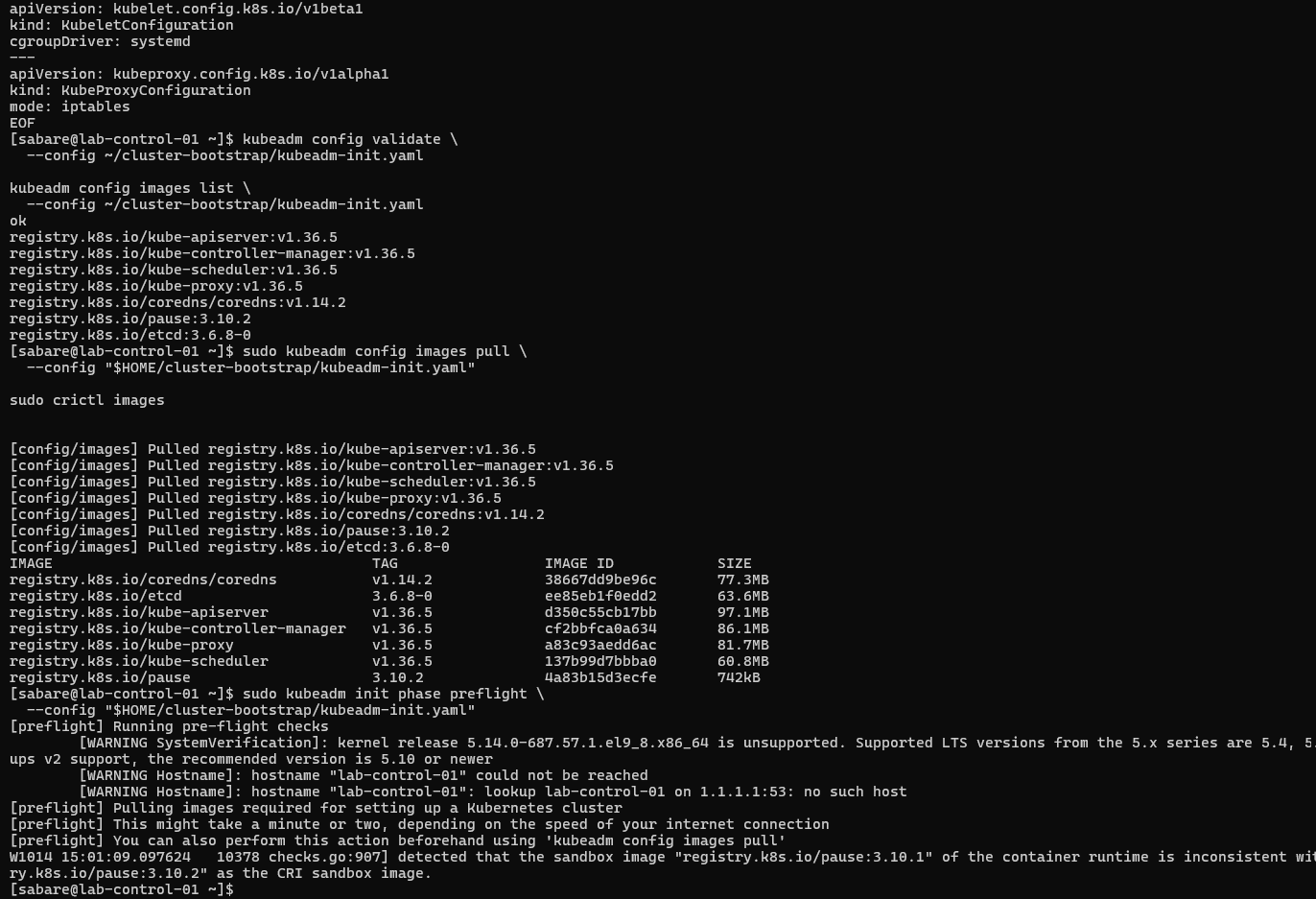
| 15:01:18 | Images and preflight | Download success and preflight warnings |
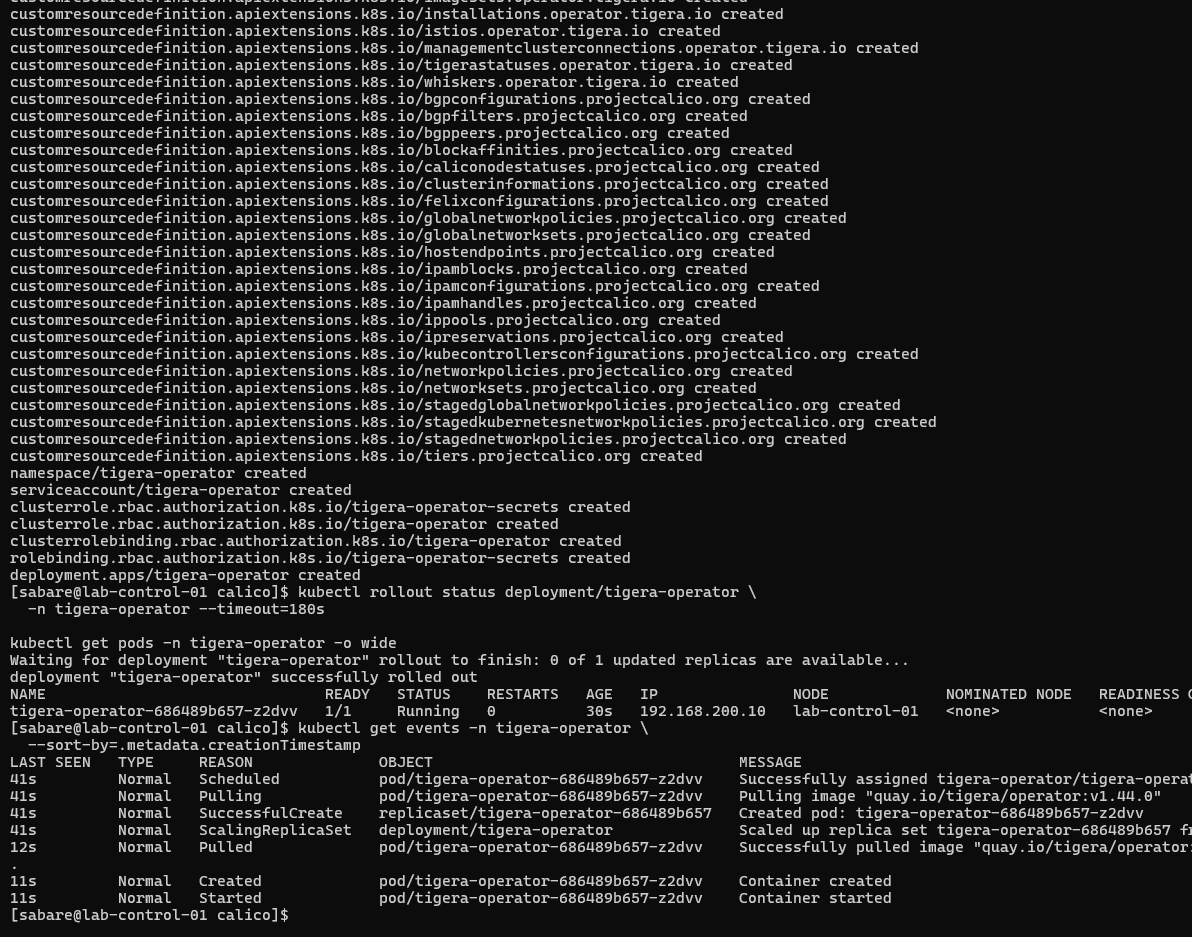
| 15:36:24 | Operator ready | Rollout succeeded, Pod 1/1 Running |
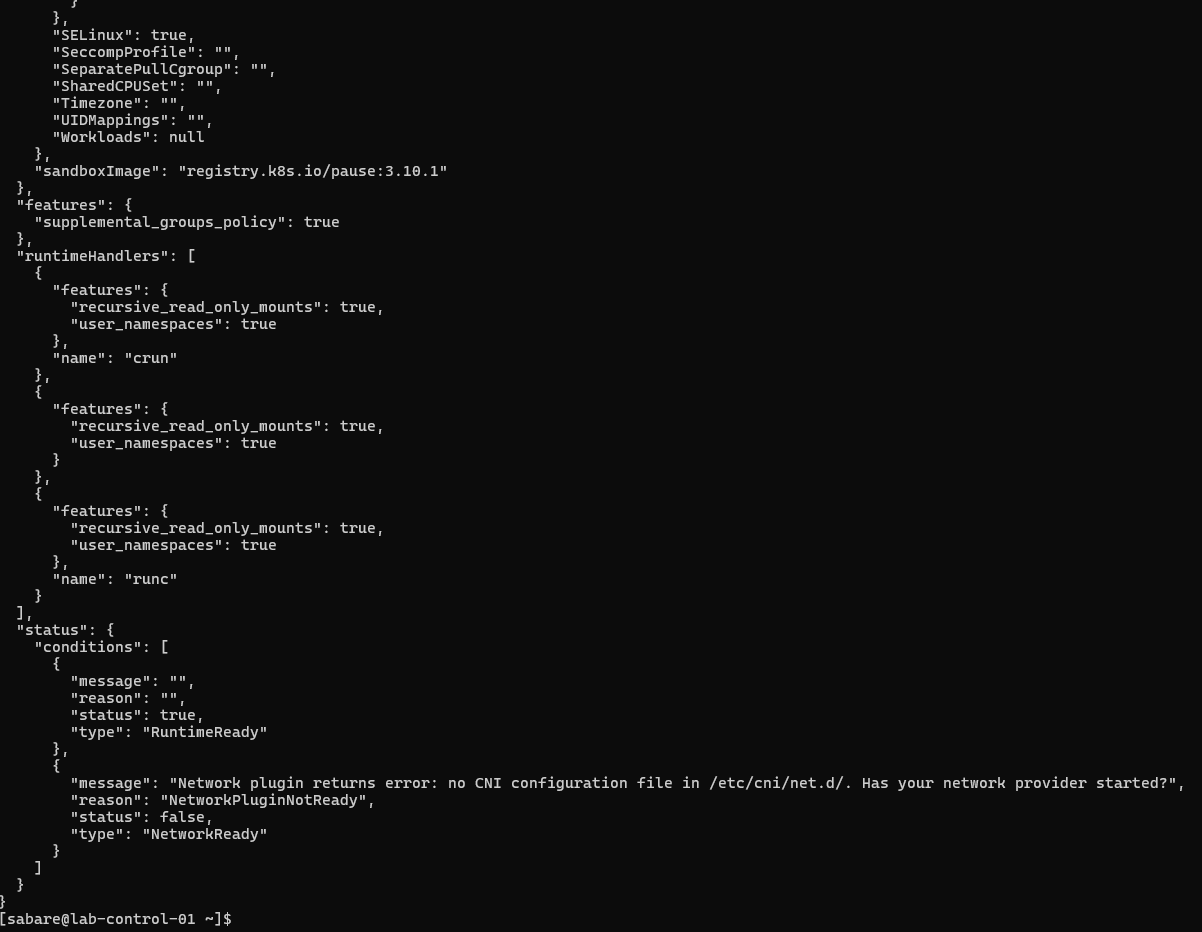
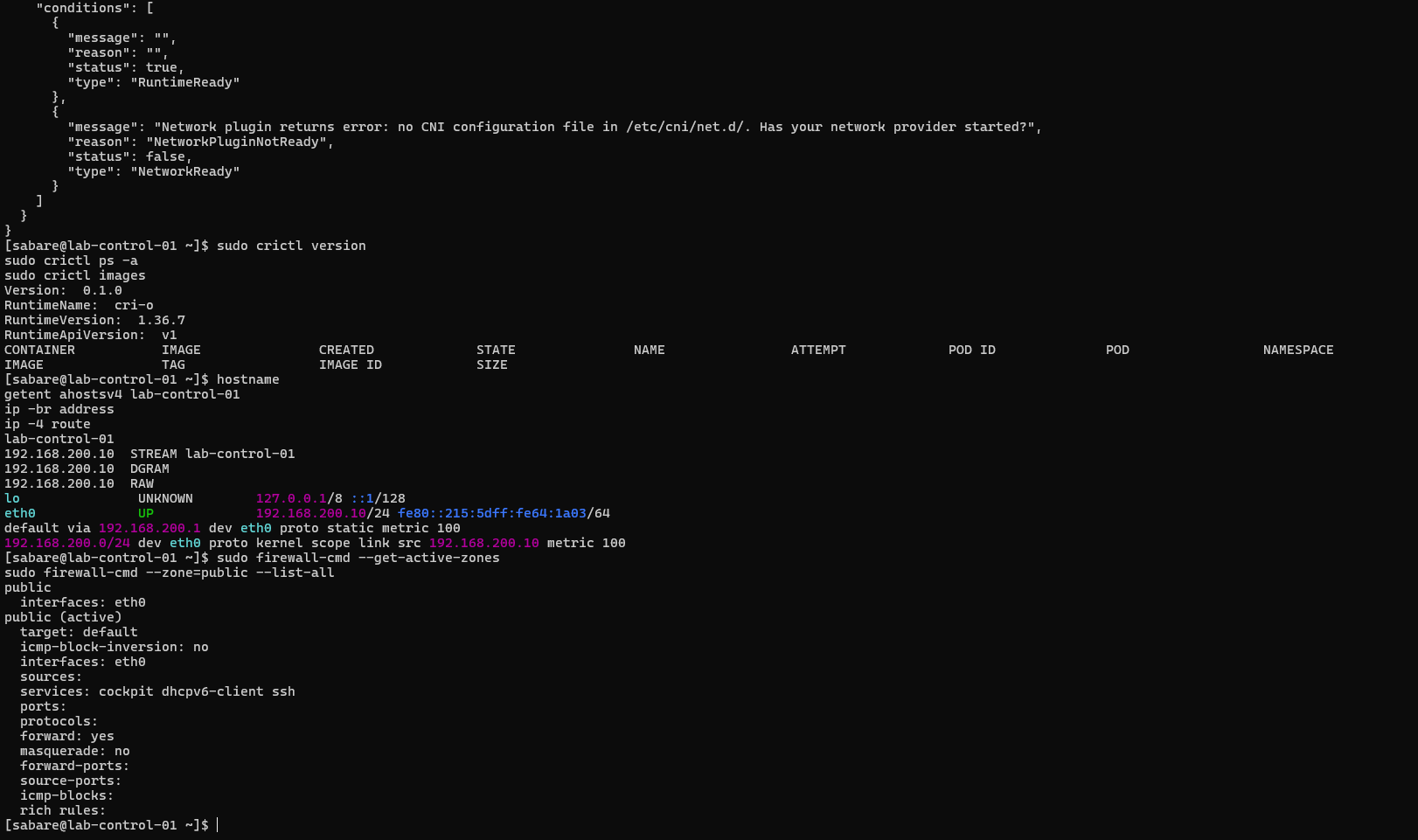
The 15:12:54 bootstrap-success screenshot is excluded because it contains a join token. Only non-sensitive results are transcribed. No token revocation is claimed. Calico network readiness is evidenced in the subsequent update below.
Network recovery and worker preparation
| Screenshot | Evidence |
|---|---|
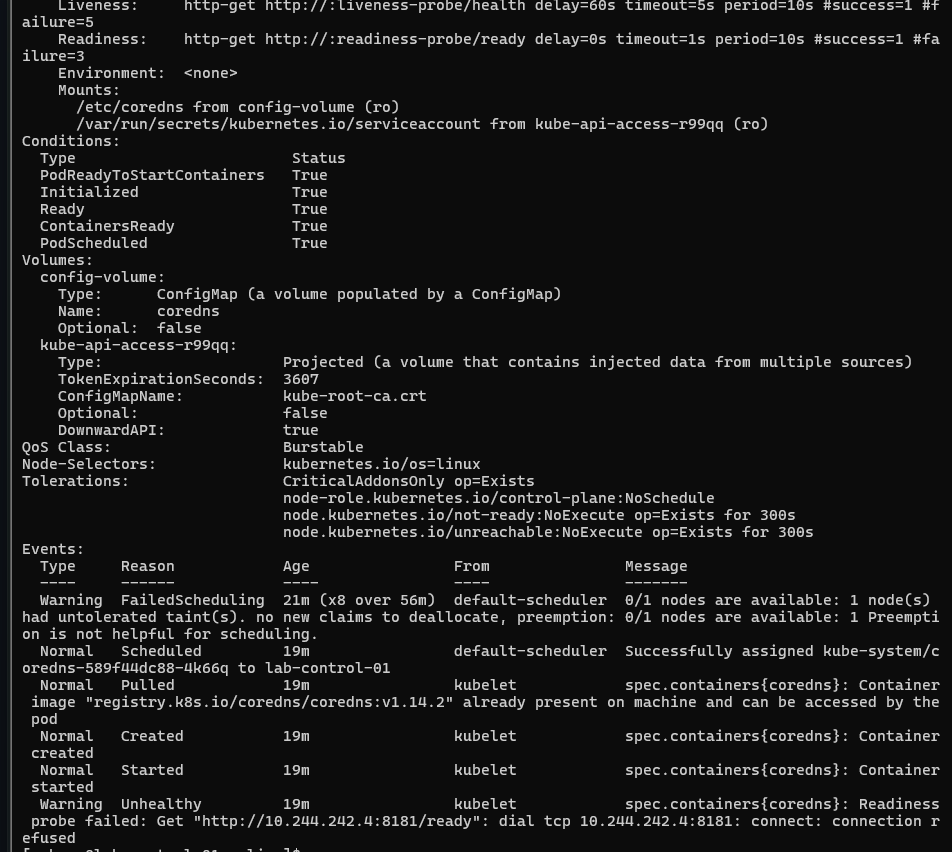
| CoreDNS recovery | Ready conditions True despite older scheduling and probe warnings |
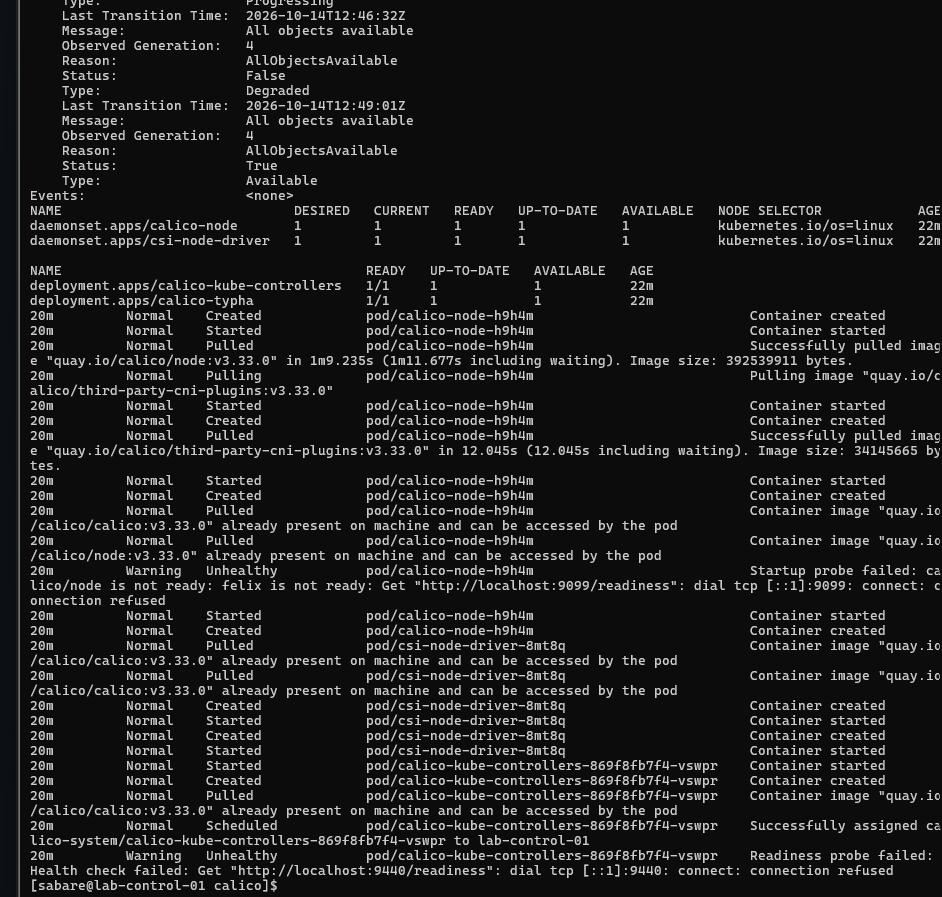
| Calico available | Available True, components ready; old startup events retained |
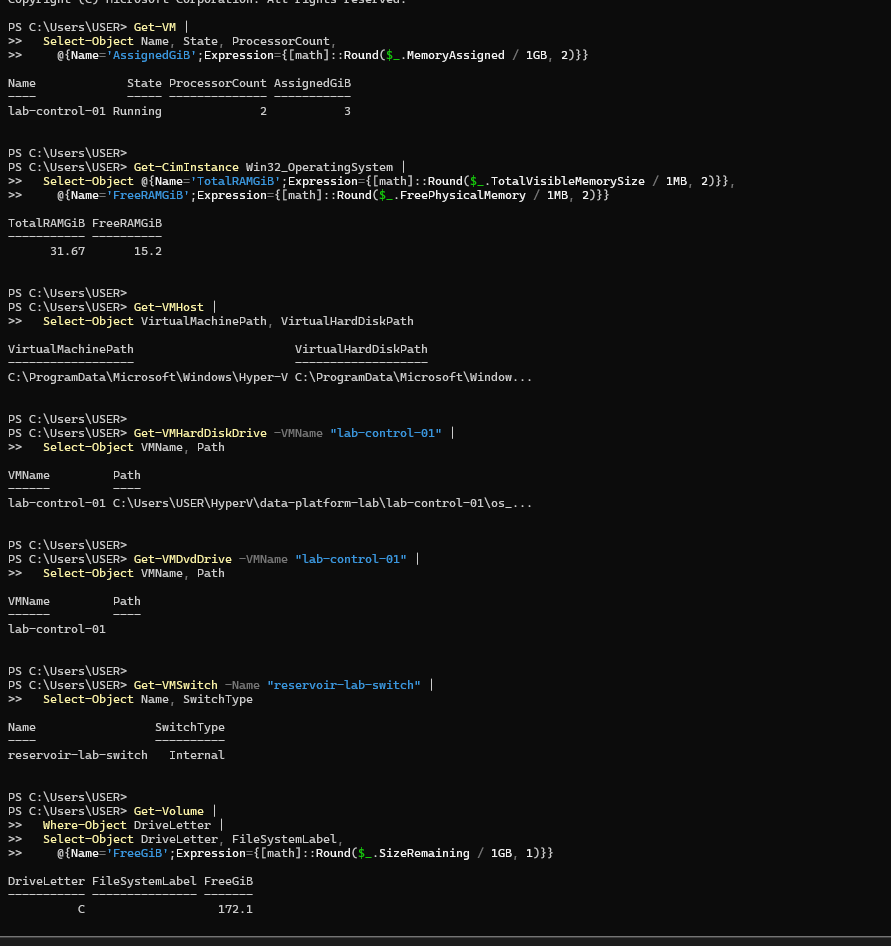
| Worker host capacity | Capacity and switch checks before worker creation |
Worker creation/settings were supplied as text, not a screenshot. Pod DNS success and test-Pod deletion were user-reported. Installer boot and installation were confirmed in the subsequent worker update below.
Worker first boot and network repair � 2026-10-15 update
| Screenshot | Evidence |
|---|---|
| Worker first boot | RHEL 9.8, hostname, guest RAM/swap and sudo access |
| Inactive Ethernet profile | Later missing IPv4 address, routes and active Ethernet connection |
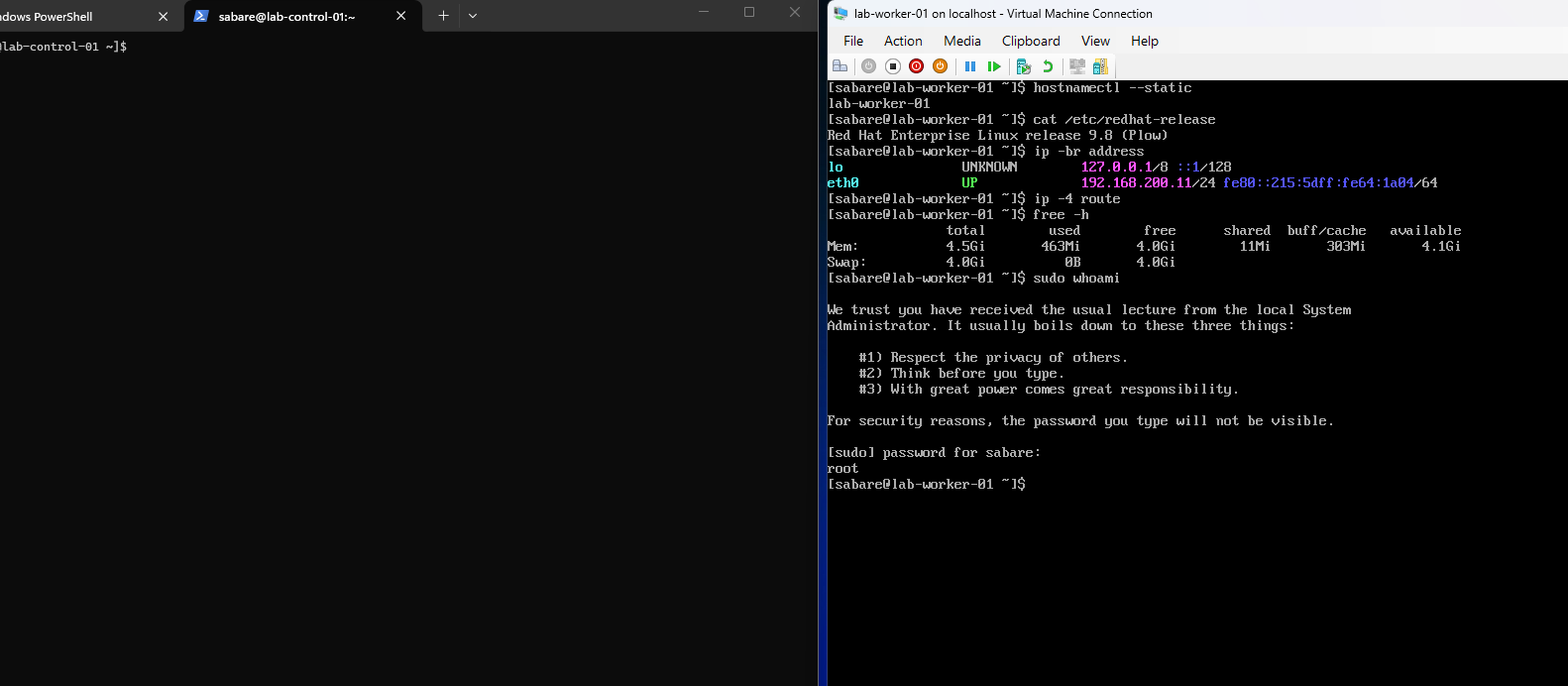
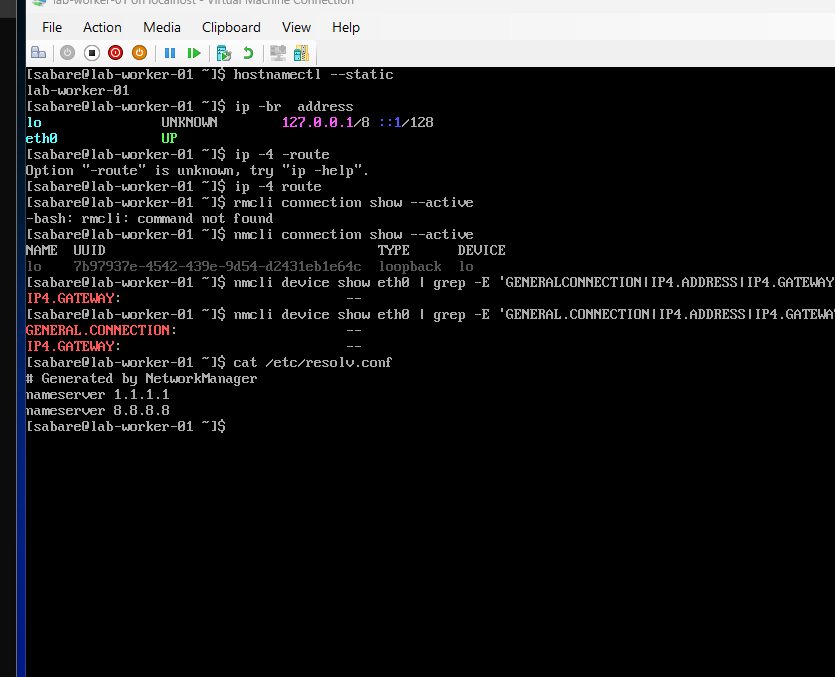
These two supplied originals were reviewed and preserved unchanged. The later HTTPS screenshot contains cookies, and registration screenshots contain account and system identifiers; their outcomes are documented in text instead. Package update completion and post-update reboot were confirmed in the subsequent update below.
Worker preparation and cross-node tests - 2026-10-15
See the worker guide. Six further original screenshots are preserved unchanged.
| Screenshot | Evidence |
|---|---|
| Worker upgrade complete | DNF Complete and newly installed kernel 5.14.0-687.58.1.el9_8.x86_64 |
| Worker kernel networking | Modules loaded, forwarding enabled, Ethernet route, SELinux Enforcing and cgroup v2; firewalld still active at this historical point |
| Worker CRI-O started | Service startup completed; a truncated warning is not interpreted as a verified diagnosis |
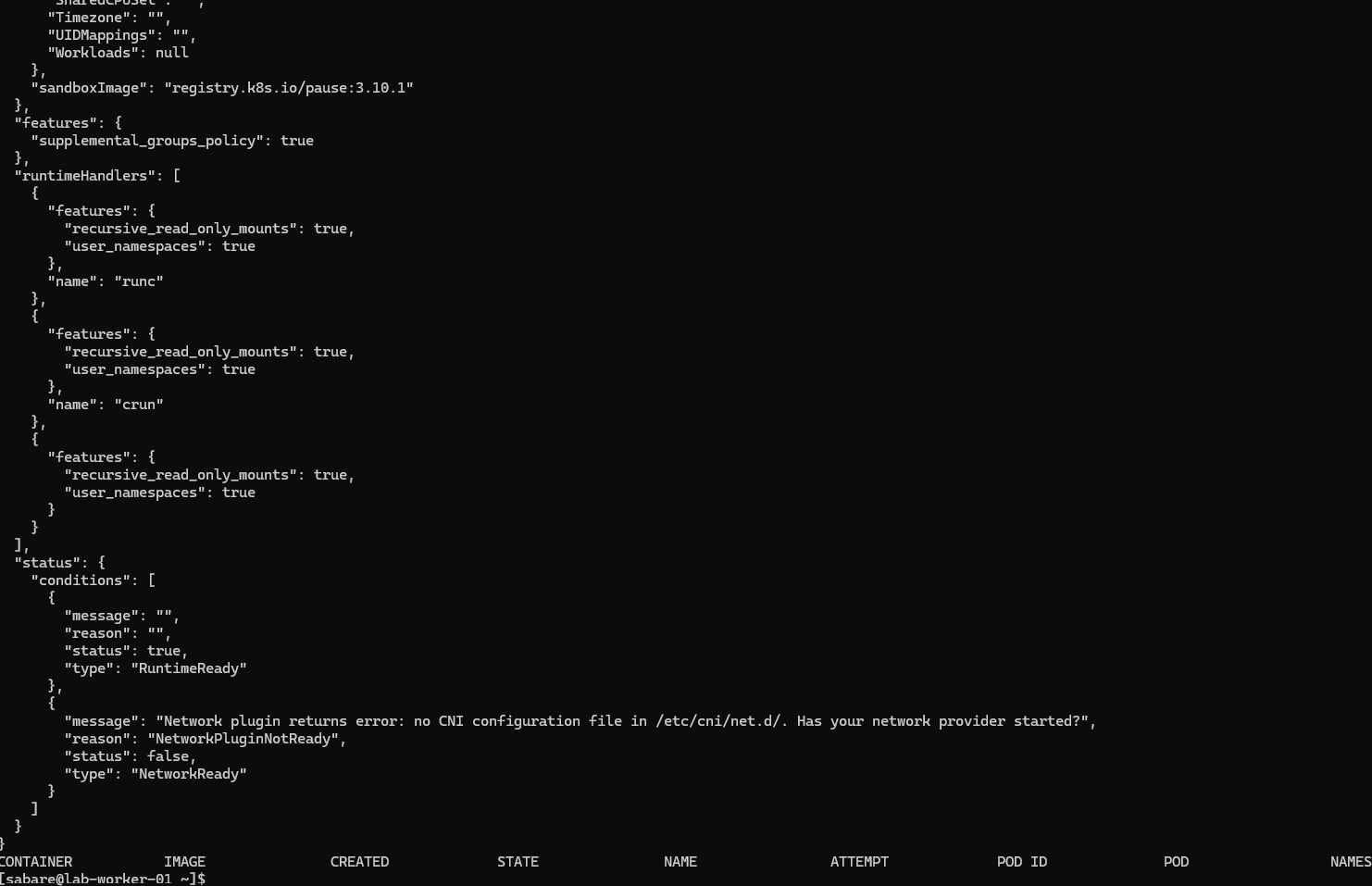
| Worker runtime ready | RuntimeReady true and NetworkReady false before joining and Calico setup |
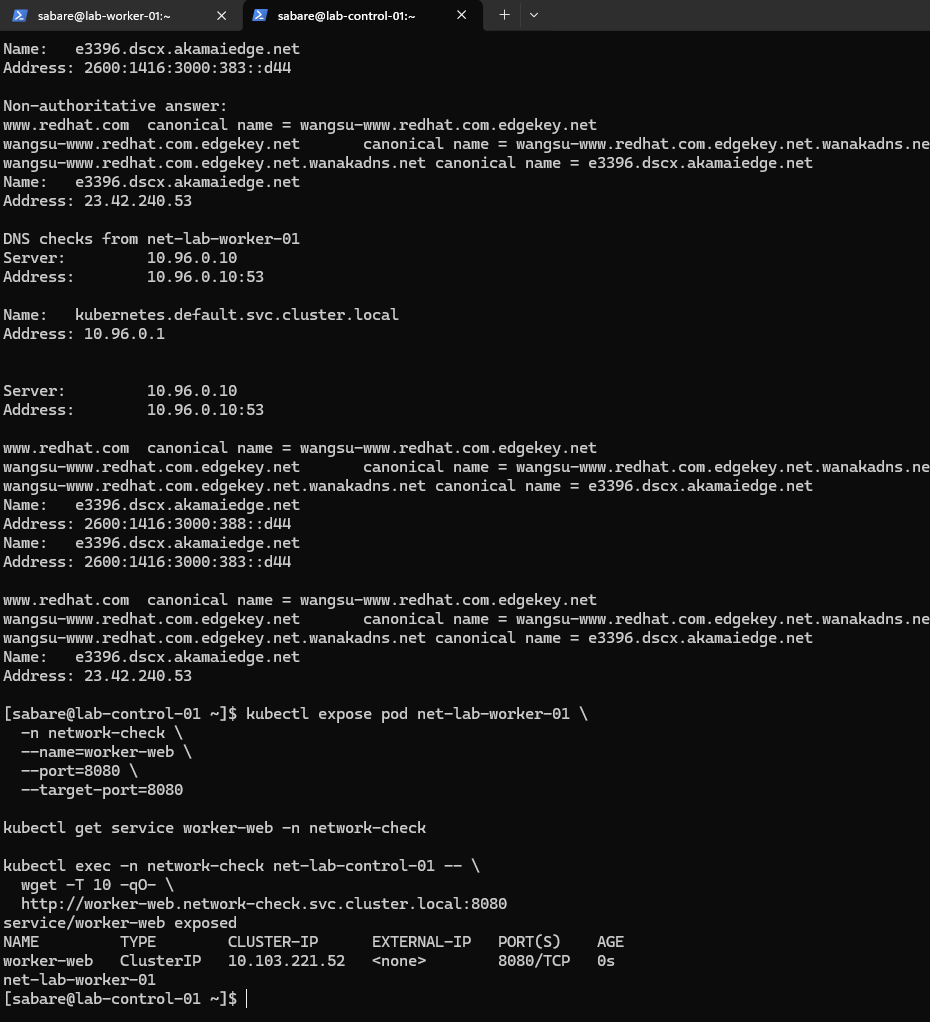
| Worker DNS and initial Service test | Internal and external worker DNS succeed; initial Service selector was subsequently corrected |
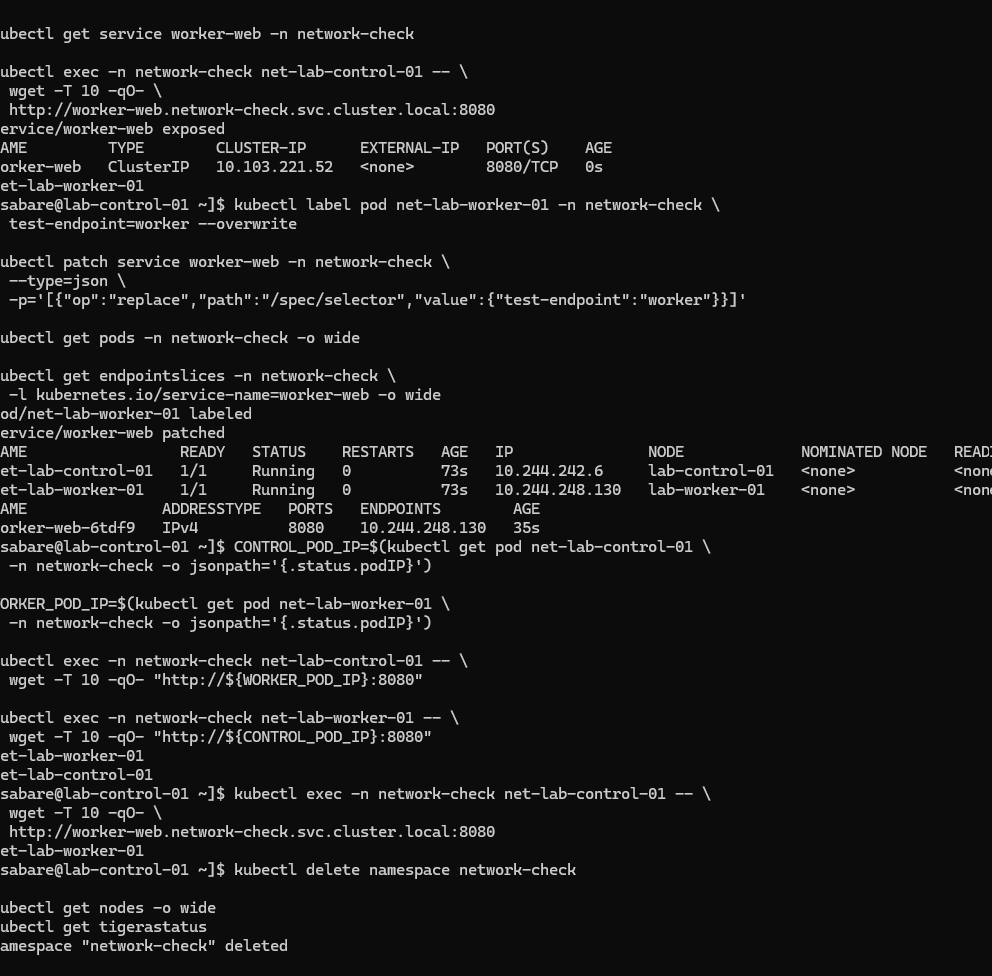
| Cross-node networking and cleanup | Worker-only EndpointSlice, HTTP in both directions, Service DNS request and namespace deletion |
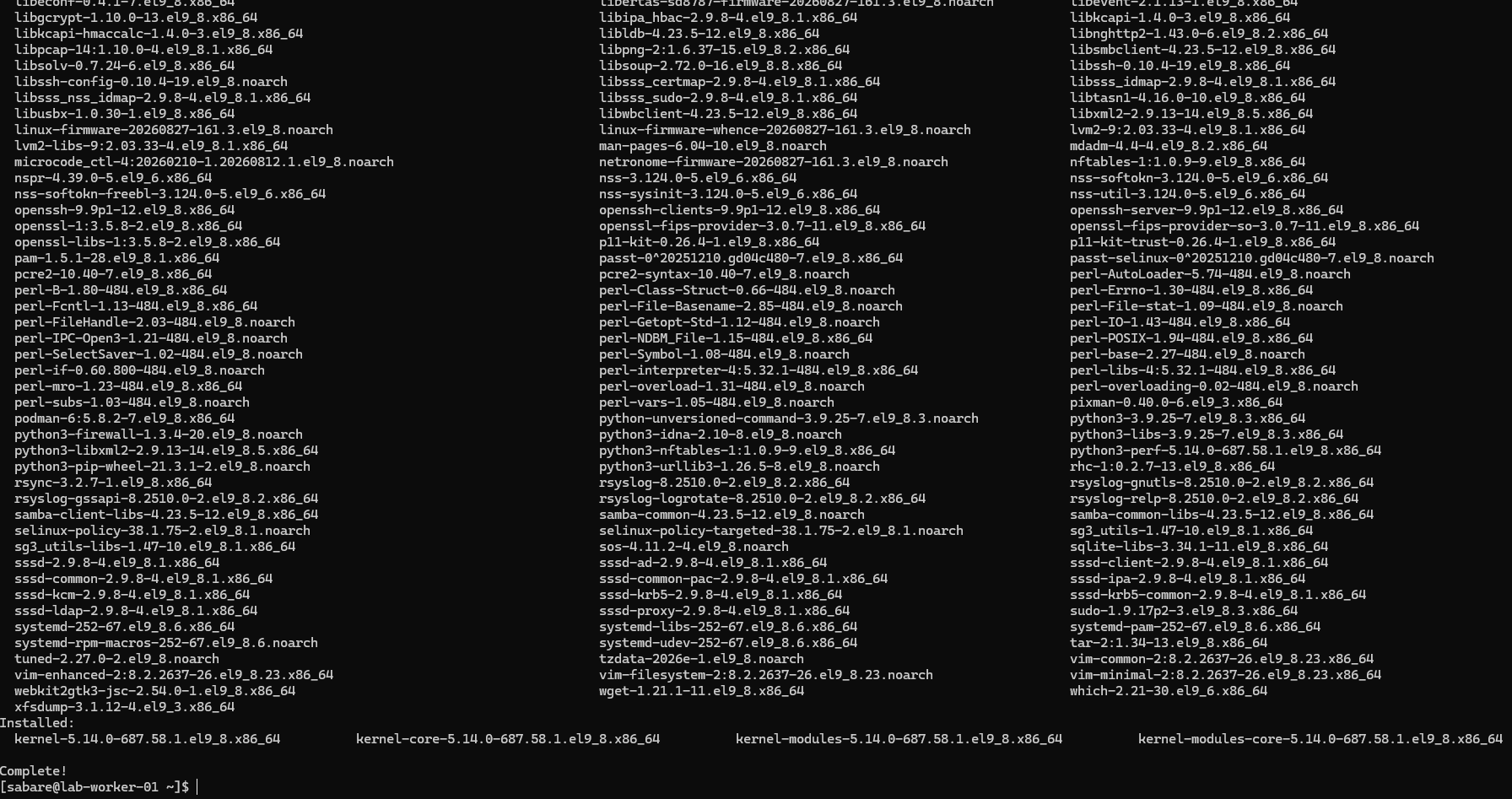
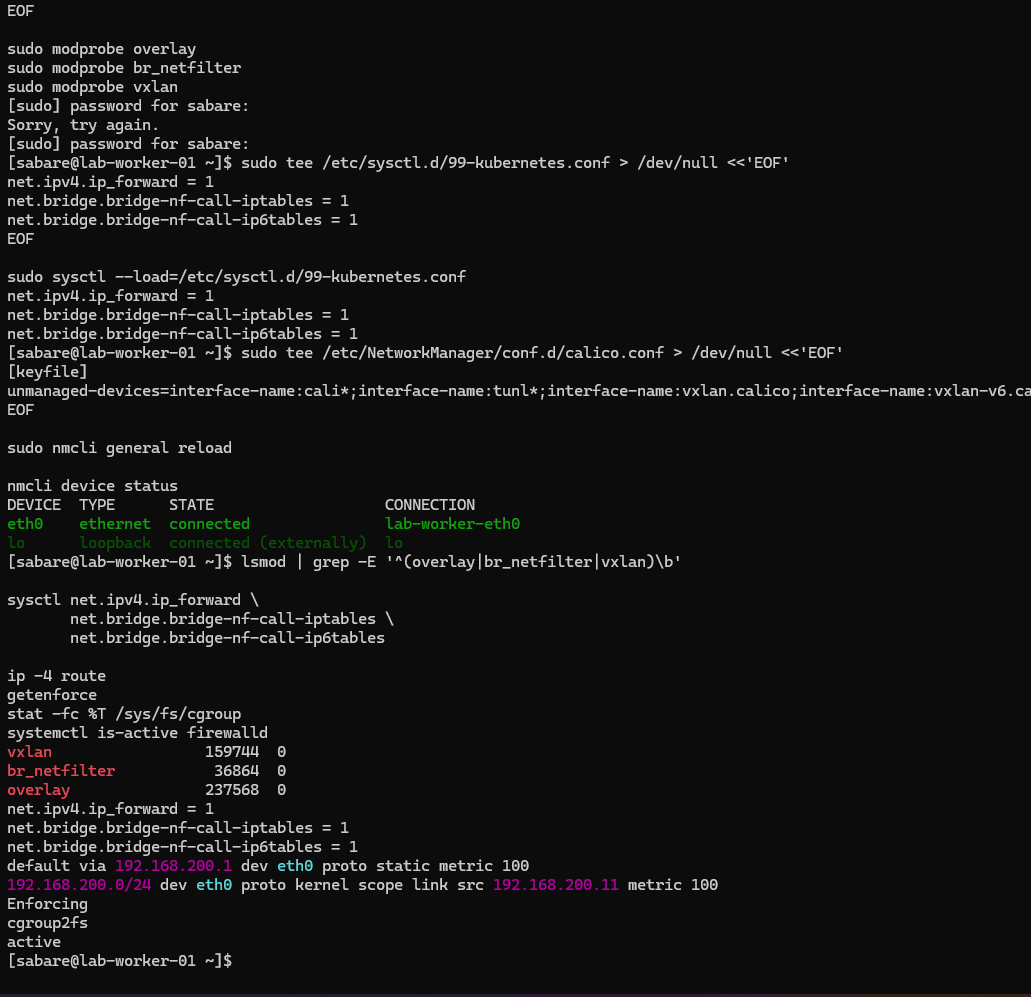
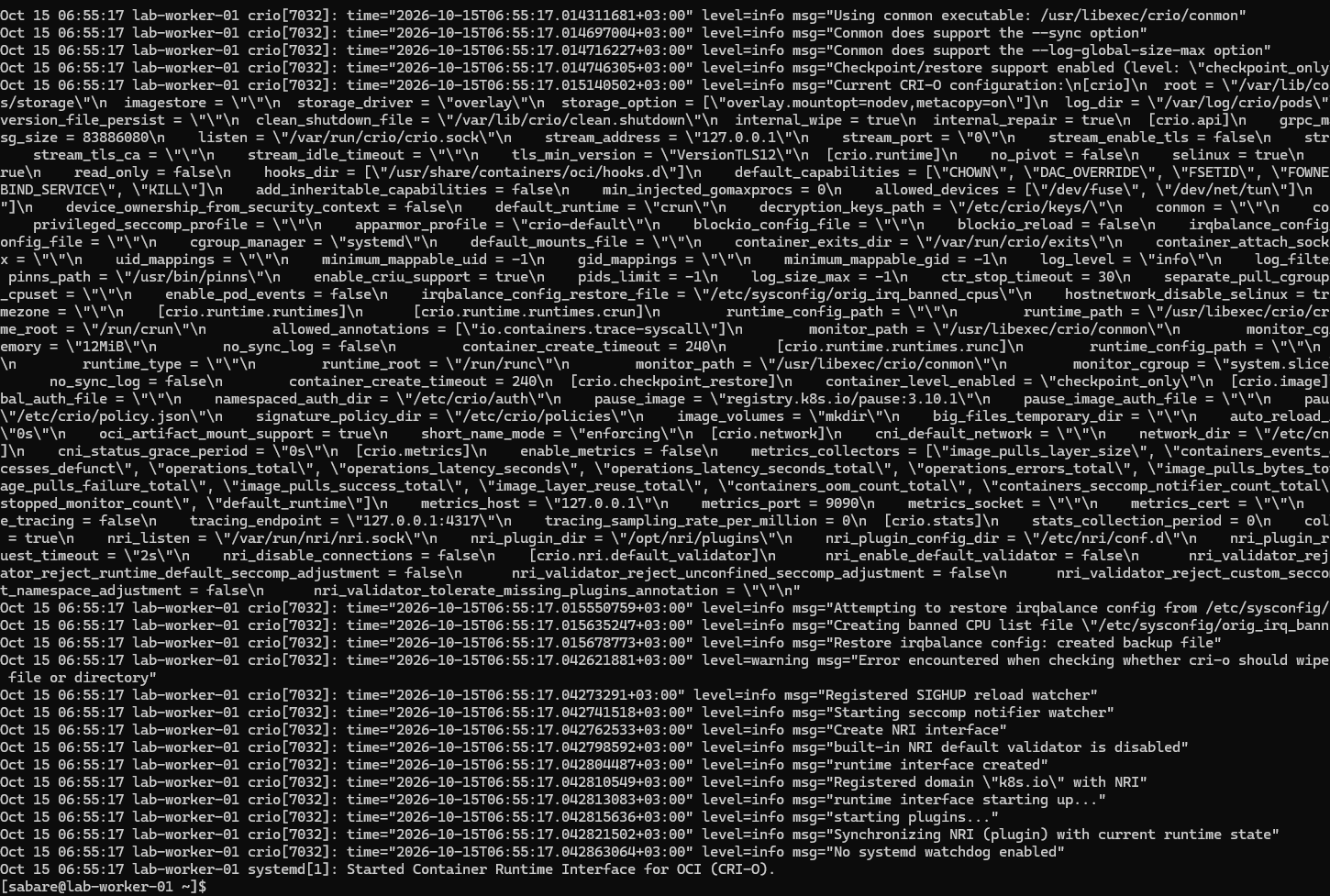
Join-command and join-success screenshots containing bootstrap tokens are excluded. No token revocation is claimed. Final node readiness and successful post-reboot swap checks are user-reported; they are not invented screenshot evidence.
Reboot recovery and second worker - 2026-10-15
Twelve additional original screenshots, unchanged, accompany the second-worker guide.
| Screenshot | Evidence |
|---|---|
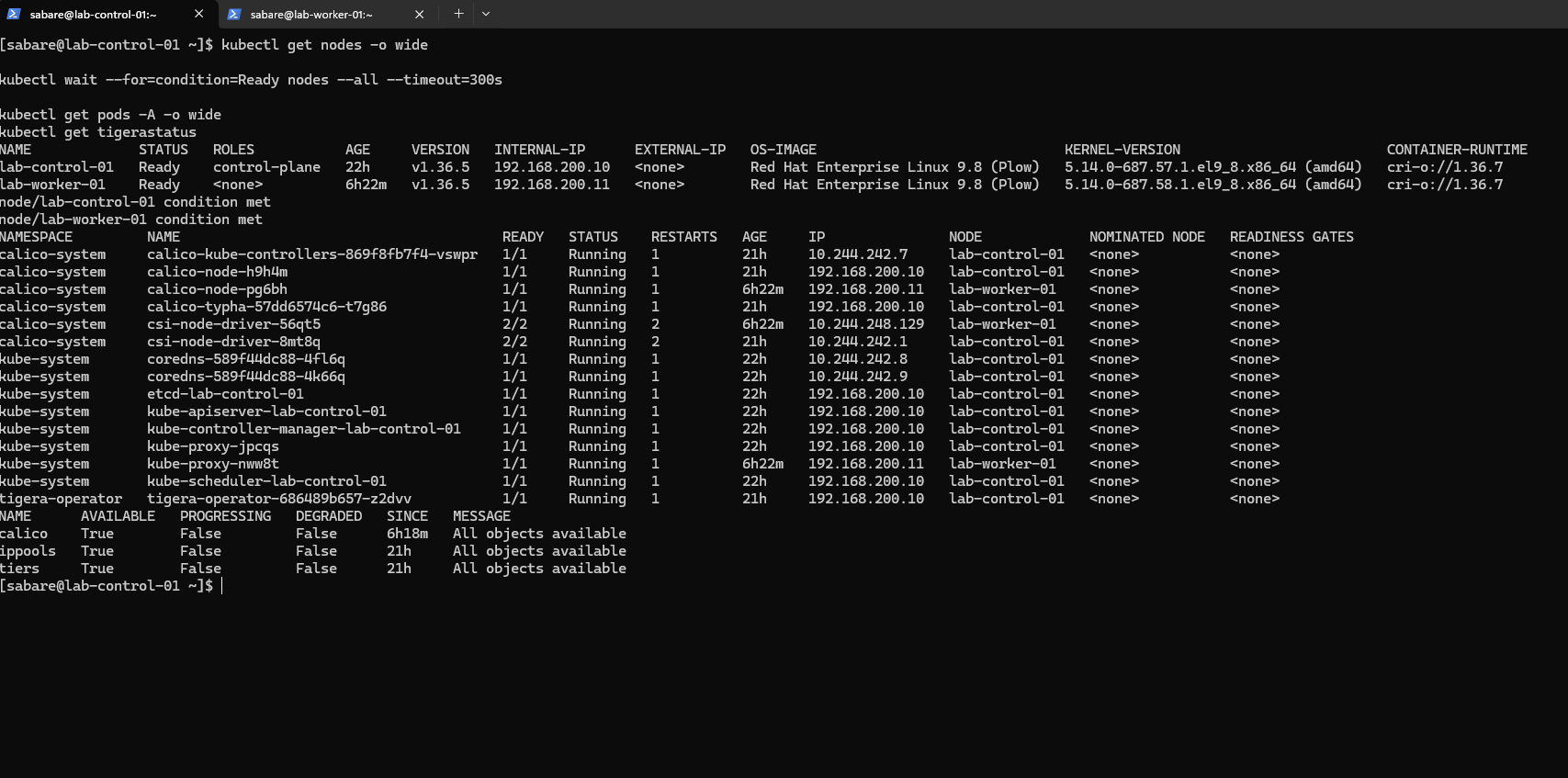
| Two-node reboot recovery | Both nodes Ready and Calico available after laptop shutdown |
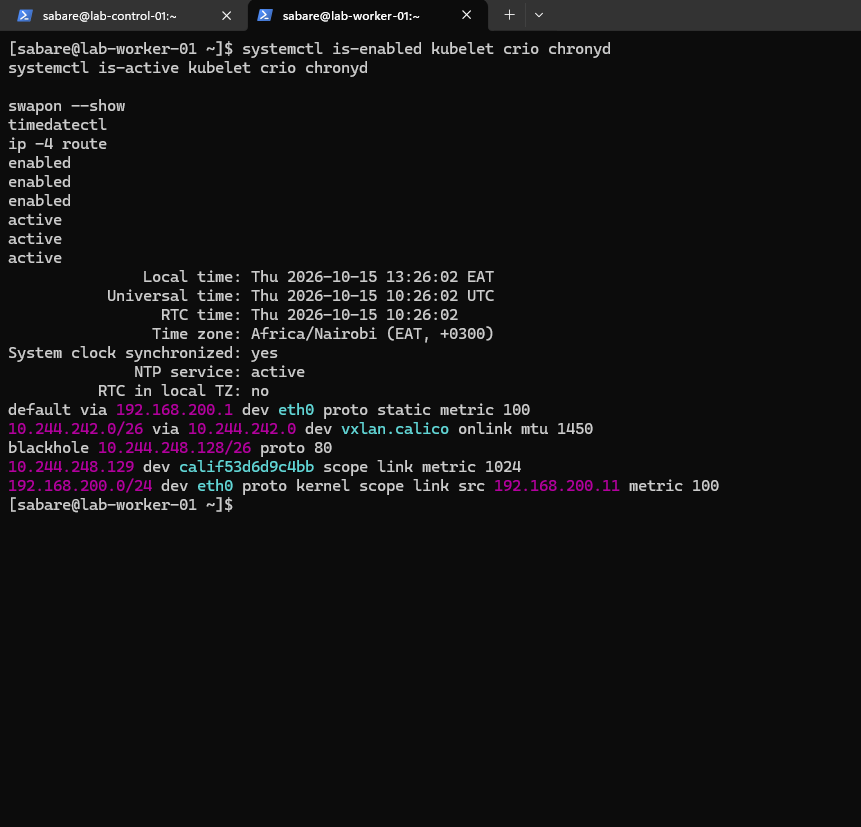
| Worker 01 boot services | kubelet, CRI-O and chrony enabled/active, no swap and VXLAN route |
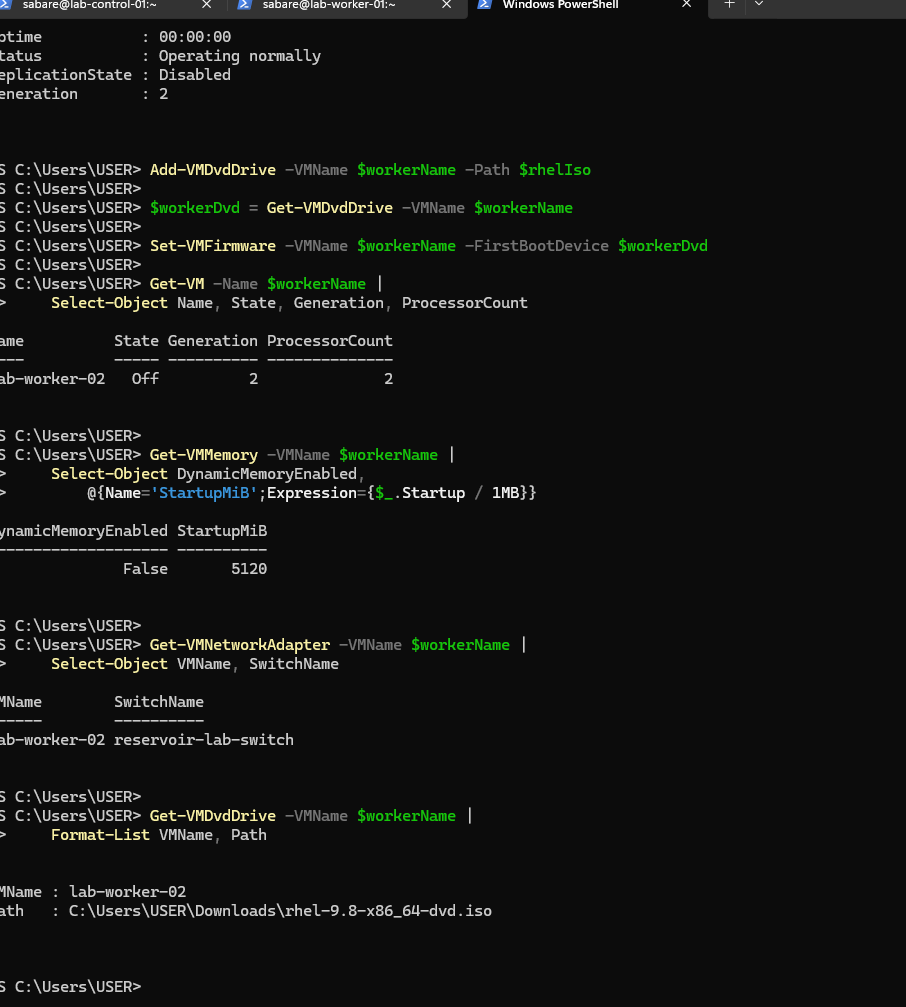
| Worker 02 VM configuration | Generation 2, two CPUs, fixed 5120 MiB, switch and ISO |
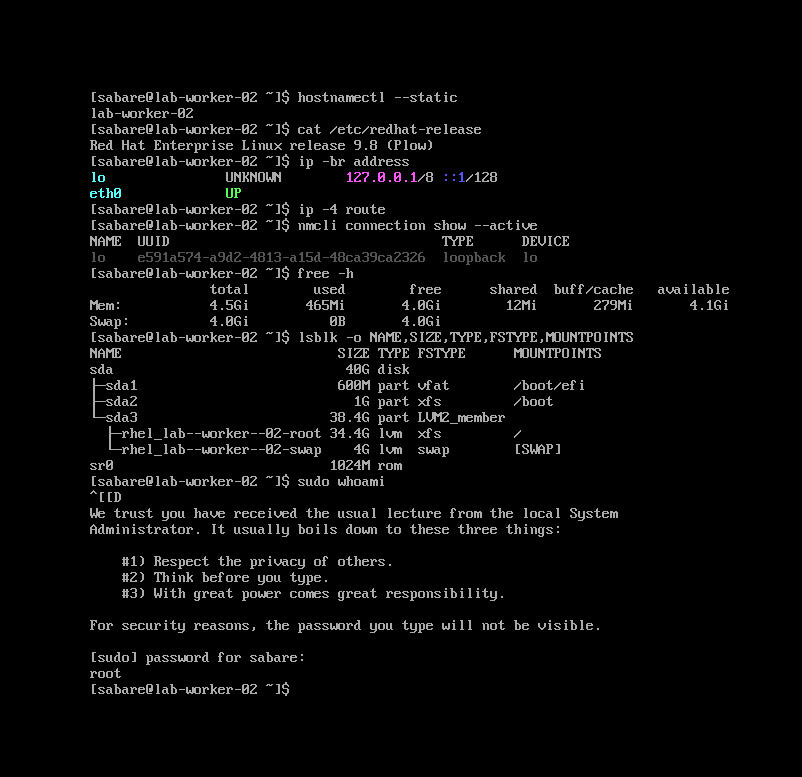
| Worker 02 first boot | RHEL 9.8, hostname, RAM, 40 GB disk and sudo; initial Ethernet address absent |
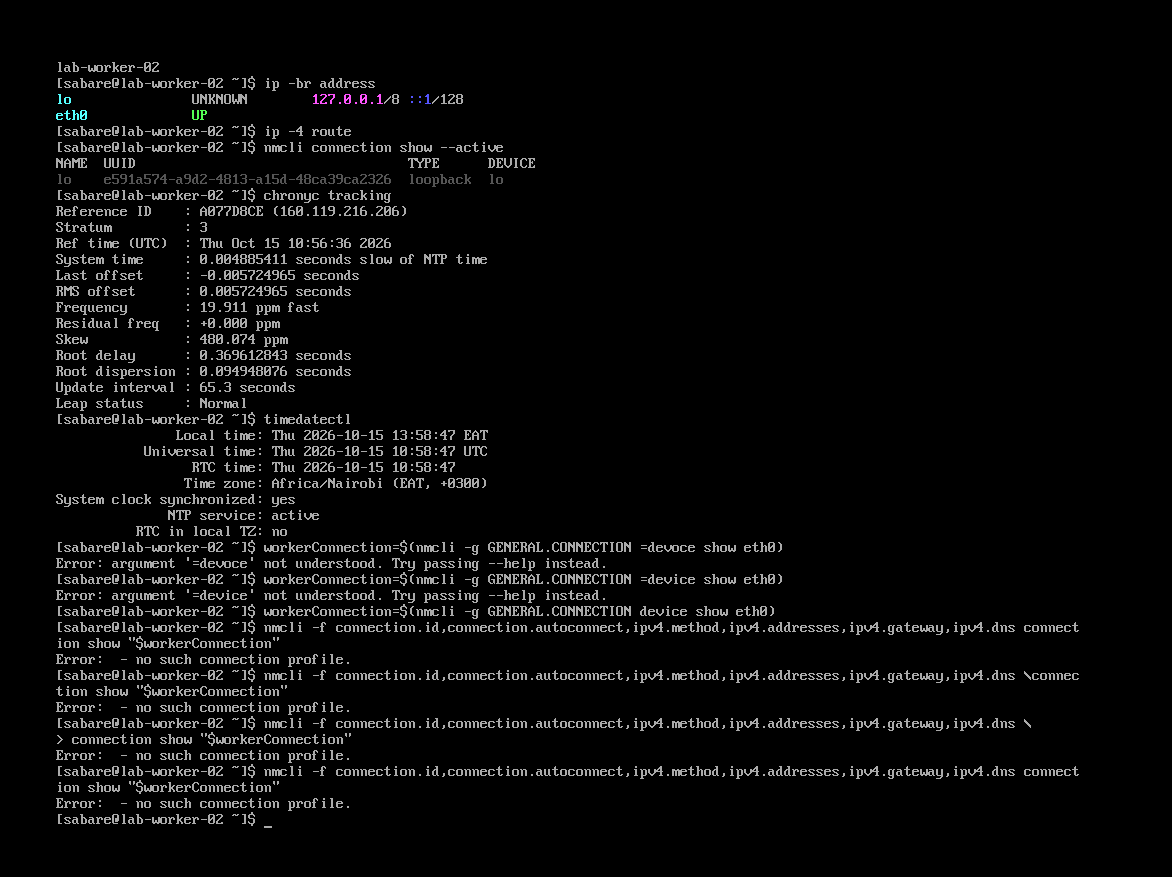
| Inactive worker network | No address or routes; only loopback active; profile lookup failed |
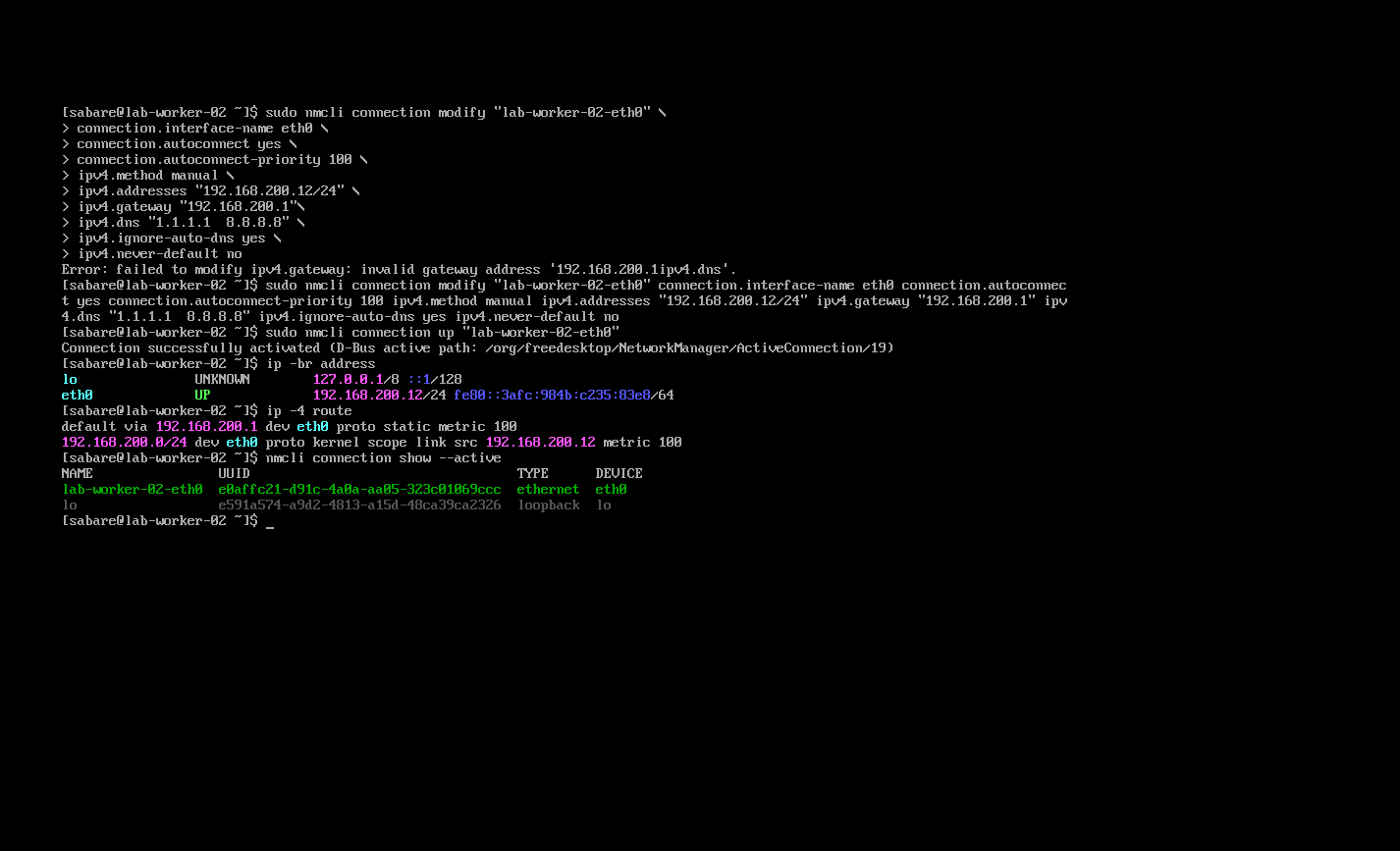
| Worker network repaired | Corrected profile activates at 192.168.200.12 with default route |
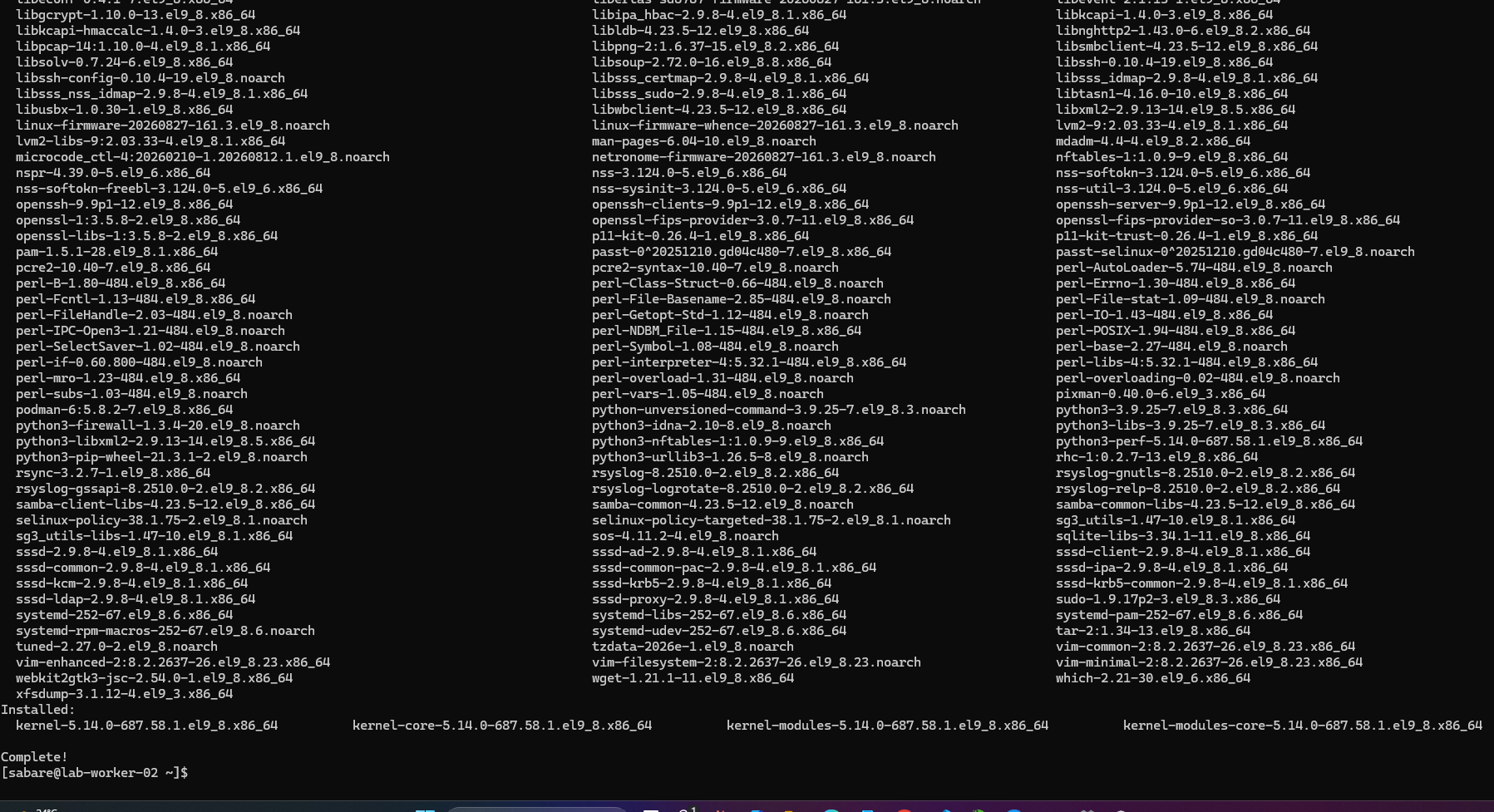
| Worker upgrade complete | DNF Complete and kernel 5.14.0-687.58.1 installed |
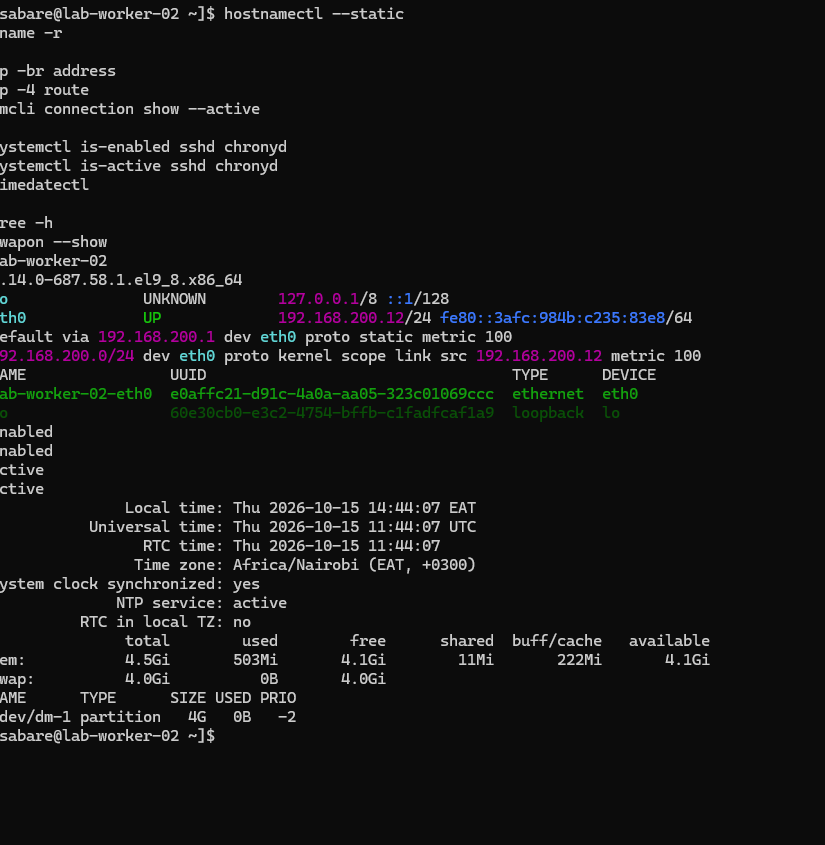
| Worker post-upgrade checks | Updated kernel running, network retained and clock synchronised; swap still active historically |
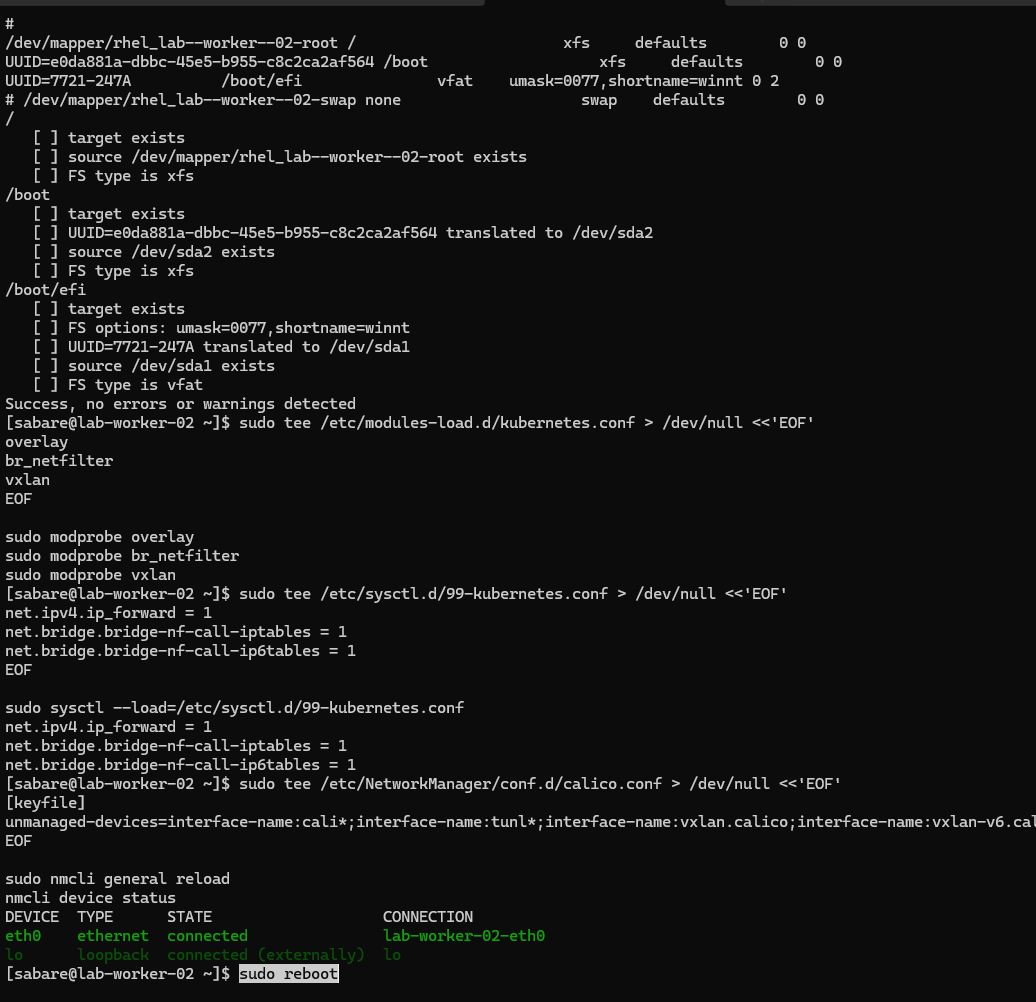
| Swap and network preparation | fstab validation passed; modules, sysctls and NetworkManager exclusions configured |
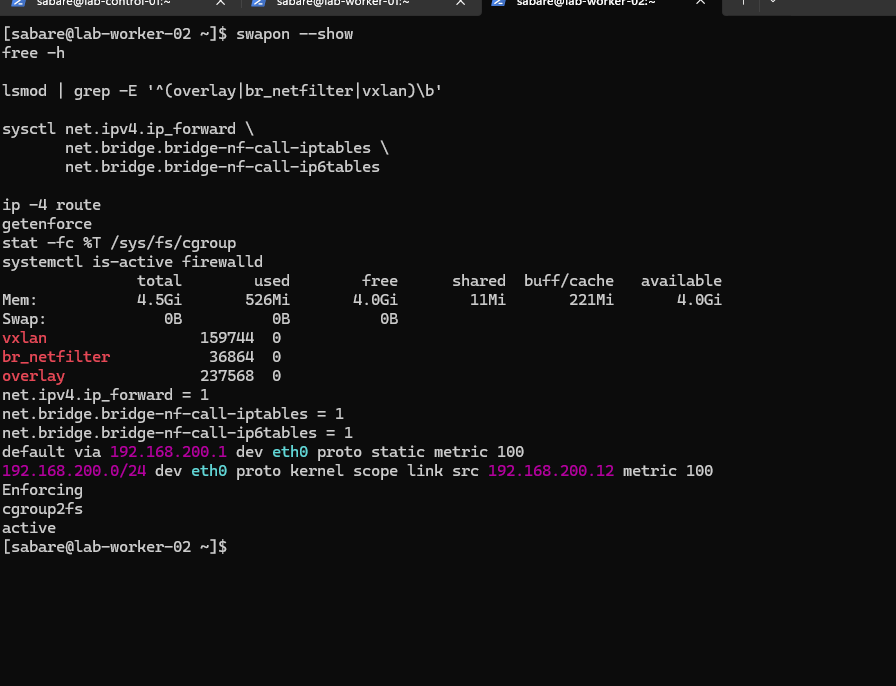
| Prerequisites after reboot | Swap 0B, modules present, sysctls 1, SELinux Enforcing and cgroup v2; firewalld active before later setup |
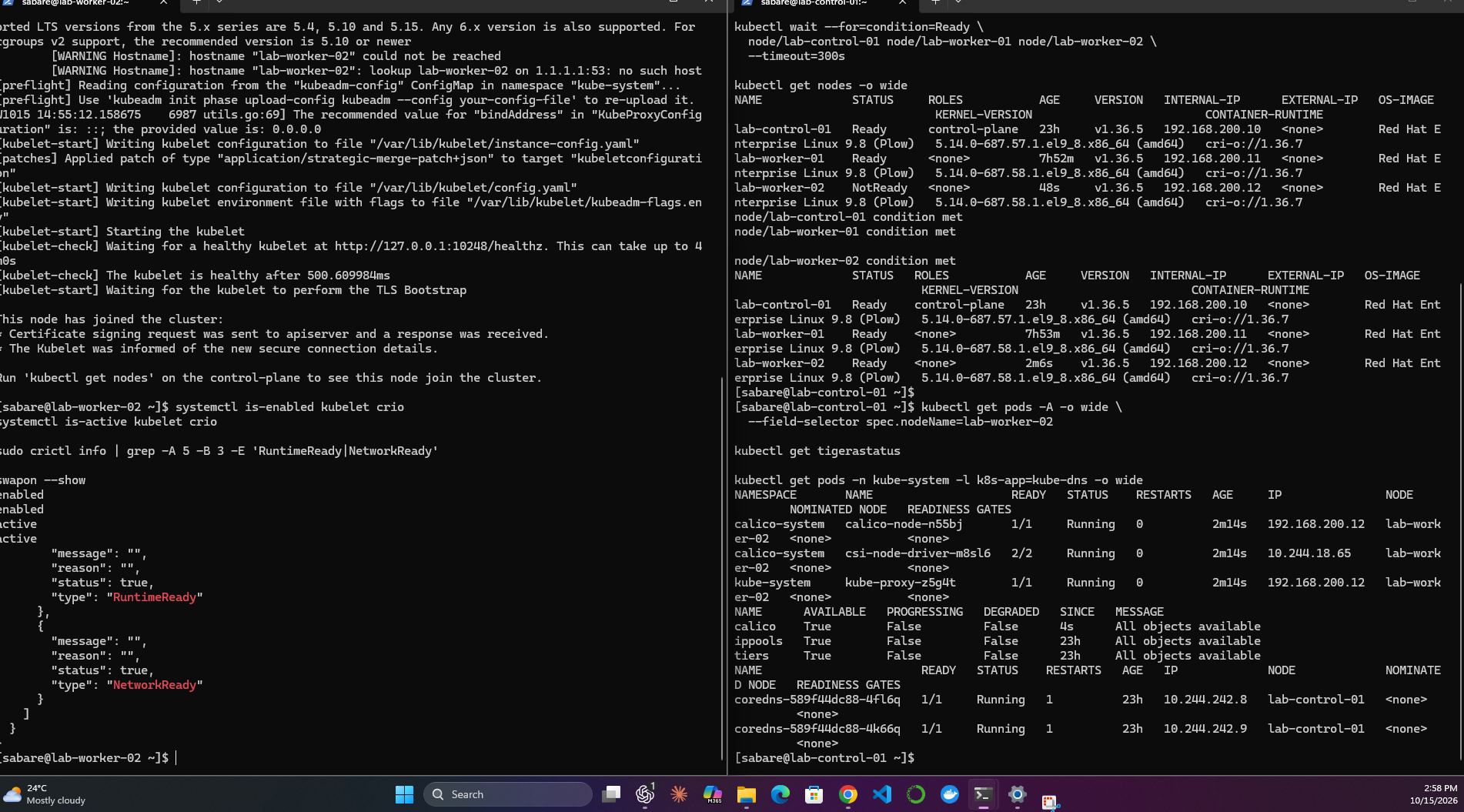
| Three-node cluster ready | Worker 02 transitions to Ready; Calico available; runtime and network ready, services enabled/active |
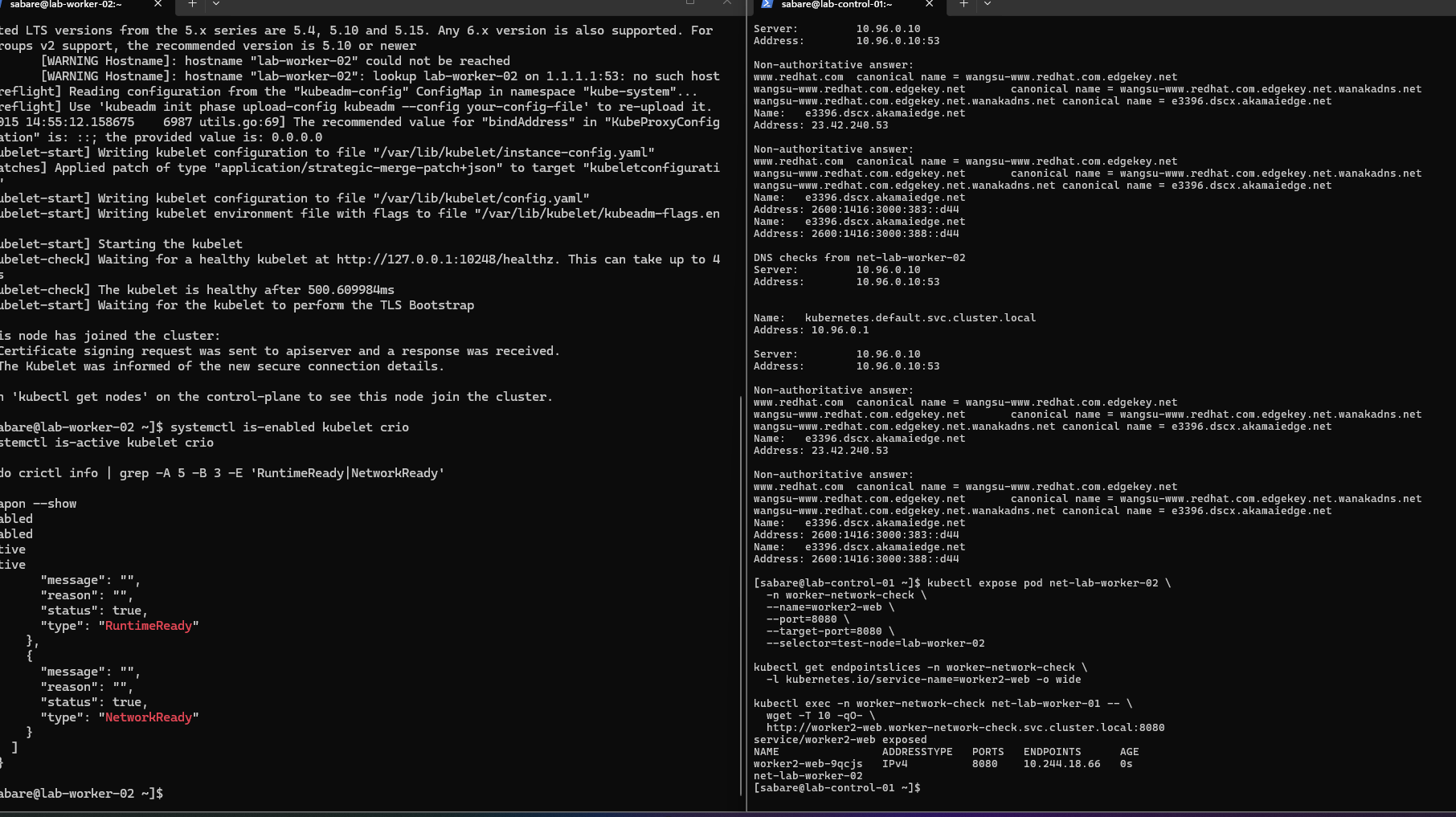
| Worker-to-worker DNS and Service | DNS answers, worker-02-only endpoint 10.244.18.66 and HTTP response net-lab-worker-02 |
Worker 02 registration identifiers, HTTP cookies and token-bearing join captures are excluded. Later captures show join results without the token-bearing command. Test cleanup is user-confirmed rather than visible in the final capture.